Reston Spring

Reston Spring
Reston Spring

Tuesday, July 15, 2014

Is this the answer to Silver Line TIFIA funding . . . or anything?

In a post on the apparent deal reached by the House Ways & Means Committee to assure as short-term fix to financing the Highway Trust Fund (and, therefore, providing $2 billion in TIFIA financing for the Silver Line), Len Burman at the Tax Policy Center (a joint effort of the Urban Institute and Brookings) calls it a "stupid tax trick."  Here is some of what he has to say:

. . . Tomorrow (July 10), his (Chairman Dave Camp, House Ways & Means Committee) committee will consider a proposal to partially pay for topping up the highway trust fund with a cynical budget gimmick called “pension smoothing.”
Revenue Effects of "Pension Smoothing"In a nutshell, here’s what it does: Companies can postpone contributions to their pension funds. This means that their tax deductions for pension contributions are lower now, but the actual pension obligations don’t change, so contributions later will have to be higher—by the same amount plus interest. In present value terms (that is, accounting for interest costs), this raises exactly zero revenue over the long run.
Let me say that again using all capital letters to express my frustration.
THIS $6.4 BILLION REVENUE PROVISION RAISES NO REVENUE OVER THE LONG RUN!!!
In fact, it could cost the government money if underfunded pension plans can’t meet their future obligations and the Pension Benefits Guarantee Corporation must step in. . . .
Pretending to raise revenue, while adding to our long-run fiscal woes and undermining the retirement security of American workers seems like the worst possible option.
Here is the link to the full post.  

According to Bloomberg News, the proposal also calls for other measures to generate the funding required.  "The House and Senate proposals both generate nearly $11 billion, according to the JCT summaries. They include customs fees, changes to pensions that lower companies’ short-term contributions, and revenue from a leaking underground storage tank fund."

Yes, folks, as usual, Congress can't see past the next election cycle in planning anything for our country.  And why not sock it to workers' pensions a decade or so from now when one's vote on this proposal is long forgotten--yet there is still another election in front of each Congressman.

Congress just can't solve a problem without making things worse these days.

Letter: Rescue Reston Input for Phase 2 Reston Master Plan

Jul 15, 2014 — Rescue Reston input for Phase II

Dear Reston Master Plan Special Study Planners:

Reston National Golf Course is restricted under the Reston Master Plan to use as “open space,” such as a park, nature center or golf course.

We greatly appreciate that the Fairfax County Board of Supervisors supported their Department of Planning and Zoning’s determination regarding the previously proposed development of Reston National Golf Course. Rescue Reston stands firm in our commitment to defend Reston's open space, and with the previously stated support of our cause from the Reston Association and the guidance of our legal representatives, we will actively defend the current zoning should any alternative use be proposed.

According to page 22 of http://www.fairfaxcounty.gov/dpz/comprehensiveplan/policyplan/parksrec.pdf, the County has a standard of one hole of golf for every 3,200 citizens. Using a projected Reston population of 114,118 we need 36 holes. Golf is the only County Park Facilities Standard that Reston already meets, and at no expense to taxpayers. Reston has two privately owned, publicly accessible golf courses that were part of Reston’s original design. These urban golf courses add value to the homes and businesses in Reston.

The development of Reston National Golf Course would be detrimental to the very thing that makes Reston special—a beautiful, thriving and diverse community achieved through well-balanced planning that matches available space and infrastructure with residents. Further development of this open space (by which we mean green space – not sidewalk cafes which developers call “open space”) would weaken our current infrastructure, overburden the existing roads, add additional students to Reston schools already operating at capacity, and diminish our quality of life.

Rescue Reston has over 3,860 signers on the combined paper and online petitions to uphold the zoning for Reston National Golf Course. Should a new threat arise – this number will grow dramatically. As John Varner of Reston commented on the online petition just 5 days ago: “Quality of life. Green space and recreation is important to city dwellers.”

Respectfully submitted,

Connie Hartke, President
Rescue Reston

Monday, July 14, 2014

The planned Silver Line opening is like a cheap melodrama....

Will the hero save the poor heroine tied to the railway tracks by the evil contractor before she is hit by an oncoming Silver Line train?

It's beginning to look like the hero (if there is one in this pathetic little melodrama) may have more time than we may have been led to believe if DTP/Bechtel doesn't pick up the pace of its repairs, replacements, and other needed work to get the Silver Line operating. 

In fact, while it is all getting rather tiresome, but here's the latest from RestonNow on DTP/Bechtel's slovenly effort:

Metro: Unfinished Work Remains as Silver Line Opening Day Looms

by Karen Goff | July 14, 2014 at 11:55 am | No Comments
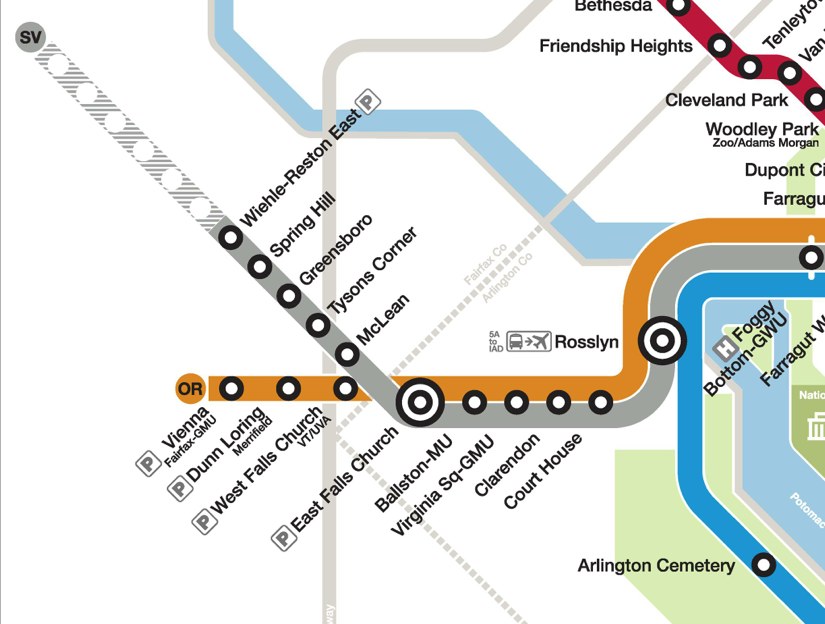
 Metro SIlver Line Map/Credit: MetroMetro is still planning to open the Silver Line on July 26 even though work remains unfinished by Bechtel contractor Dulles Transit Partners.
Metro spokesman Dan Stessel said on Monday that several items DTP should have completed by now are not finished.
One area — the application of heat tape on the third rail — is to be done by the end of July according to the post-operational readiness agreement. Stessel says the heat tape work has not even started.
“It has been disappointing to us to see that the contractor has not been taking advantage of every available work window,” he said. “They could have done much more.”
Stessel said DTP has also not resolved water leaks at several stations. He said that the heat tape, which prevents freezing so it isn’t urgently needed in July, can be applied after opening. . . .
Click the headline to read the rest of this ongoing story of ineptitude and overspending.  

Sunday, July 13, 2014

Dulles Toll Road users shoulder an increasing share of Silver Line’s costs, Washington Post, July 12, 2014

July 12 at 7:26 PM
Dulles Toll Road users are shouldering nearly half of the costs of Metro’s soon-to-open Silver Line, a far bigger share than originally predicted.
Those drivers also face the biggest exposure for any additional cost overruns or delays on the rail line set to open July 26 — seven months late and $150 million over budget.
Commuters are vulnerable because tolls are the one share of the Silver Line project’s funding formula that is not capped at a fixed dollar amount or percentage of the final tab.
Since construction began five years ago, there have been five toll increases that spiked a common round trip from $2.50 to $7 or, viewed as a monthly tab for typical weekday commuters, from $50 to $140.
The impact of the line’s rising costs has been painfully apparent to drivers who use the road regularly. Yet the significance of rising tolls as a main funding source drew less public attention than heated intrastate political battles and engineering skirmishes over tunnels. . . .
Click here to read the rest of this article. 

While the increases in tolls on the Dulles Toll Road and their role in financing the Silver Line are not news to toll road commuters or Reston 2020 blog readers, their importance can not be ignored and we appreciate the Post picking up on this unfair and inequitable assignment of Metrorail costs to those who will or can not use the Silver Line for their purposes.

Although former Fairfax Board of Supervisors Chairman Kate Hanley is quoted as being "amazed" by the role highway tolls play in financing the rail line, the Fairfax Board under her successor, Gerry Connolly,, was specifically responsible for promoting and approving the 2007 "Funding Partners Agreement" that set this arrangement in place without so much as a public hearing. 

Without TIFIA funding--which is clearly a possibility as the Highway Trust Fund dries up in the next month without Congressional action--CDMSmith forecast that tolls would rise to $18 full toll each way by 2050 (about $7-$8 in today's dollars).  With TIFIA funding, tolls will still rise to about $12 each way, meaning an annual toll bill of about $4,800 for Dulles Toll Road users. 

And just for clarity, we would note that MWAA is paying only 4.1% of the rail construction costs (about $240 million)--less than half what it will cost to build the station at Dulles Airport and the rail line across Airport property ($587 million according to MWAA's April 2011 cost analysis).  And, oh yeah, MWAA will be leasing its land along the Silver Line to developers at a huge profit in the years ahead.  Fair, reasonable???

Of course, now Congressman Connolly is singing a different tune as he practically broke his arm patting himself on the back for his role in garnering a TIFIA funding commitment for the Silver Line.  While we appreciate his efforts along with those of Rep. Frank Wolf and Virginia Senators Warner and Kaine to gain this reduced-cost funding commitment, we know--and so do they--that this financial arrangement is unfair, inequitable, and quite possibly imprudent in the long term--even if TIFIA comes through. 

Before we sign off here, we will reiterate again that Reston 2020--and most Restonians--welcome the arrival of the Silver Line in Reston and its future extension into Loudoun County.  We believe it will be an important ingredient in the continuing economic health of our community.

We do, however, continue to object in the strongest possible terms to the abominable financial arrangements that force people who are not be able to use the Silver Line for any reasonable purpose to pay the largest share of its construction cost.  It is a disgrace and a mockery of sound public policy. 

Thursday, July 10, 2014

Column: Changing of the Guard at Reston Citizens Association, John Lovaas, Reston Connection, July 9, 2014

Some extracts from John Lovaas' column on the new RCA Board of Directors and their predecessors:
The recent Reston Citizens Association (RCA) Board election, although it received little media coverage, was an important event for Reston. RCA Board members who provided the energy and intellectual leadership to inform and advocate for the community on critical issues have stepped down. In particular, we’ll miss President Colin Mills who provided a steady flow of thoughtful reporting and commentary on vital issues like the Byzantine master plan process (Phase 1) and the county’s stealth plan to eviscerate Reston Regional Library. Terry Maynard, with Dick Rogers, did extensive research and analyses involving as many as 60 volunteers during the master plan process. Their extraordinary analytical effort was of such high quality that major American think tanks, like Brookings would likely be proud to put their covers on their work, useful and timely information Reston readers got free from RCA. . .
Over the years, RCA has had its ups and downs, depending largely on the skill, energy and commitment of its volunteer Board. In recent years, leadership has been strong. RCA has advocated effectively for the community, been a source of independent information and a watchdog both of government and the Reston Association (e.g., new RA facilities and land swaps). . .
New RCA President Sridhar Ganesan, with a financial and operations management background, is new to community work. But, I am impressed with his grasp of RCA, community dynamics, and commitment to give priority to Phase 2 of the Master Plan process, providing community input on library reform, strong support for accessibility improvement and candidate forums. Vice President John Hanley, passionate activist Tammi Petrine, and Rescue Reston leader Connie Hartke provide needed leadership continuity on the Board. I wish the entire Board all the best. Reston needs a strong, independent RCA.
Click here for the full article.

Wednesday, July 9, 2014

Letter: County Falling Behind on Its Housing Goals, Michelle Krocker, Reston Connection, July 8, 2014

Below is a letter from Michelle Krocker, Executive Director Northern Virginia Affordable Housing Alliance, and a friend of the Reston Citizens Association and its Reston 2020 Committee, published in this week's Reston Connection.  As longstanding supporters of Bob Simon's vision of providing housing for all in Reston, both RCA and Reston 2020 have been enthusiastic in principle to the adoption of a residential studio unit (RSU) zoning ordinance conditioned only by some basic protections for existing neighborhoods.  We certainly recognize the many complexities that effort encountered.  We at Reston 2020 regret that these concerns could not be addressed constructively and the RSU proposal has been shelved.  We hope that the lessons learned in this process will stimulate a renewed County effort to assure housing for all county-wide, especially in Reston.

Here is Michelle's letter:
On June 9, the Residential Studio Committee of the Fairfax County Planning Commission voted to recommend that the review of the Zoning Ordinance Amendment for Residential Studio Units be tabled. This recommendation will be voted on by the full Planning Commission at its July 24 meeting and it is almost certain that it will be adopted. After months of committee hearings and community meetings throughout the county, the RSU amendment will be quietly put to rest.
What were the factors that defeated this proposal? They were many and varied, including:
  • virulent community opposition;
  • fear of overcrowding, which is a real issue in some parts of the county;
  • an abject lack of knowledge by the larger community about the issue of housing affordability — who needs it, current housing costs, income levels of the workforce, the impacts on our quality of life;
  • a zoning ordinance that didn't allow the flexibility needed to develop these units;
  • absence of leadership from the Board of Supervisors in communicating the county's growing unmet housing needs and helping to shepherd a community discussion that was balanced and respectful.
Is Fairfax County committed to providing housing that is affordable for all its residents?
While the Board of Supervisors unanimously adopted the Ten Year Plan to End Homelessness in 2007 and the Blueprint for Housing in 2010, they have done very little in the ensuing years to provide the resources needed to implement these plans. In 2009, when the county reduced the Penny Fund for Housing to a half cent, the financial resources to leverage private capital to preserve and develop new affordable housing were lost (the remaining half cent is used to pay the debt service on the bonds issued for the Wedgewood Apartments acquisition). From 2005 to 2009, the One Penny Fund preserved over 2,200 units of affordable housing. Since 2009, the number of new or preserved units serving households earning less than $64,000 or 60 percent of area median income has declined significantly.
The FY2015 Housing and Community Development budget provides $5 million for new construction or a preservation project of 120 units, and approximately $3 million for Bridging Affordability, a rental subsidy for households moving out of homelessness. This is a paltry amount of funding for a county of this size and wealth. As has been famously said, "show me your budget and I'll show you your priorities."
Other policies to provide funding for housing have been studied and tabled by the Board of Supervisors, the most recent being the “3-2-1 policy” which would secure a contribution from commercial development in transit and high density areas of the county to support the development of workforce housing. This policy is currently in place for the Tysons redevelopment area, but board members felt that if applied to other areas of the county, it could deter new commercial development which has slowed down in the last few years. However, both Arlington and Alexandria have commercial development fee policies in place, and the result has been a significant increase in resources for affordable housing with no apparent impact on commercial development.
The unwillingness to adopt new, proven funding strategies, combined with minimal local investment in housing programs means that the county is falling farther and farther behind in meeting the goals for the 10 Year Plan and the Blueprint for Housing. How can homelessness be addressed in a meaningful way if the stock of affordable housing isn't growing? How does Fairfax County ensure that there is housing in its communities for the workforce in the retail, hospitality, health care, public sector and entry level jobs? How does the county promote the development of stable, affordable housing for homeless children, youth aging out of foster care, persons with special needs, seniors on fixed incomes and low wage working people?
The final motion on the RSU amendment at the June 9 meeting included a recommendation stating that "there be a broader community dialogue about affordable housing, including a discussion on how best to provide for a range of housing opportunities .... that will serve the county's current and future residents at all income levels." The Alliance enthusiastically endorses this recommendation, and believes the time for discussion is now. An honest community discussion would hopefully break down some of the barriers of mistrust and misunderstanding surrounding housing, and engage more members of the community in building consensus for solutions.
The growing shortage of affordable housing and the severe cost burden for an increasing percentage of the county's population is not unique to Fairfax County. This is a challenge that threatens the vitality and sustainability of the entire region, and some jurisdictions have made progress in increasing their affordable housing stock through a variety of financial and land use tools. As the largest jurisdiction and the engine of job growth for the region, Fairfax County should be the leader in addressing the housing issue. Instead, they are lagging far behind due to negligible investments and the absence of vision to address the unmet housing needs of its residents both today and in the future.