Reston Spring

Reston Spring
Reston Spring
Showing posts with label Baron Cameron Park. Show all posts

Wednesday, April 30, 2014

Op-Ed: Poor Parks, Poor Communities? Terry Maynard, RestonNow, April 30, 2014

Park“Great Parks, Great Communities” is the clichéd theme of the Fairfax County Park Authority.  And the theme may be true, but the Park Authority is promising — a promise it may well not fulfill — Tysons and Reston urban areas among the most poorly parked-served areas among the top cities in the country.
It raises the question, will poor parks mean poor communities?

As Reston Now suggests in its April 29 article, county park availability standards for the newly urbanizing areas of the Dulles Corridor are less than half of the county-wide “suburban” standard — and the Park Authority plans to put fewer parks in Reston’s station areas than in Tysons because we have parks and facilities elsewhere.

Here’s where we are in the arithmetic of public parks.  The county standards described in Tysons’ and Reston’s plans shoot for providing about 1.7 acres of park per 1,000 residents.  That’s about 154 acres of parks in Tysons and 95 acres in Reston — if fulfilled.

Now let’s see how that stacks up. A national non-profit, the Trust for Public Lands, tracks park availability annually for the 100 largest cities in the country. When Fairfax County’s urban park standard is included in the ranking of acreage per 1,000 residents, both Tysons and Reston rank in the bottom 5 percent of all the cities.
 

If Tysons and Reston achieve the county urban goal, they would bracket New York City’s Manhattan Borough near the bottom of the list. Yet Manhattan has two and one-half times the density planned for Tysons and more than three times the density planned for Reston.

Moreover, despite having some of the most expensive real estate in the country, Manhattan has been able to set aside 18.3 percent of its land for parks.  That’s more than 10 times the share planned for Tysons (1.4 percent) and more than three times the goal for Reston (5.6 percent).

And the county has no intent to meet its own standard for Reston because, as the Reston Comprehensive Plan says, “Need generated in the TSAs should primarily be met through the integration of urban parks, recreation, and cultural facilities within the mixed use developments of the TSAs. To supplement these parks and facilities, elements of the larger Reston area’s robust park and recreation system (outside of the TSAs) may be able to be improved to help meet the needs of future residents and employees.”

So, yes, the County envisions that the park and natural areas that we as Reston Association members own and pay for annually in our RA assessments will count against its obligation to meet county park requirements. It is the grinding down of Reston as a special place to live, work, and play to just another mediocre county sub-division.

But that is only half the story. The other half has to do with the availability of facilities within the parks, especially space-consuming recreational fields.

Using Manhattan has our benchmark again, we find that Manhattan has 150 athletic fields (mostly baseball diamonds) serving its 1.5 million residents — or about one athletic field for every 10,000 residents.  This benchmark is not as good that planned for Tysons:  20 athletic fields for 89,000 residents or about 4,500 residents.

Reston falls way behind both:  The planned 56,000 residents of its station areas will have “at least” (and don’t expect more) three athletic fields or one for every 18,700 residents.  That’s about half the ratio found in Manhattan. It will be the worst in the country among TPL’s 100 top cities.

The rationale, as explained by the Park Authority’s Chairman Bill Bouie, “There is so much here (in Reston) already,” says Bouie. “We don’t have nearly the assets in Tysons.”

Wait a minute!  The county athletic fields in Reston serve the 60,000 people who already live here and, as Mr. Bouie knows well, are fully utilized by Restonians and thousands of people who live beyond Reston.

In fact, a recent RCA Reston 2020 on the Baron Cameron Park master plan shows that, even with the three athletic fields the current Reston urban plan proposes, there will be no improvement in the athletic field accessibility and the certainty of a major loss of athletic field accessibility if a recreation center is built in the park.

The other athletic fields in Reston are bought and paid for by the members of Reston Association as part of their annual assessments.  The apparent expectation of the county is that the residents of Reston should build more athletic fields in their 1,200 acres of common land to fulfill the county’s commitment to the community.

The picture painted here is that the county has no intention of sustaining Reston as a model planned community and, indeed, wants to take private Reston property — RA’s common areas — so that it can meet its so-called park commitment on the cheap. Actually, most RA members would like to preserve their common areas, especially their jointly-owned natural areas, rather than turn them into athletic fields to make up for shortfalls in the County’s willingness to fulfill its obligation to the community.

It is hard to imagine a more cynical county approach to providing basic, even substandard, public park services to Restonians.  Not only will Reston’s urban residents have about the worst park availability in the country, but Restonians will be forced to absorb the overflow into their privately-held common land — and pay for it.

Soon we will be living with poor parks and a much poorer community as the result.

Terry Maynard, Co-Chairman
RCA Reston 2020 Committee

Thursday, April 17, 2014

Colin Mills: ResTown Hall Meeting on Baron Cameron Park, RestonNow, April 17, 2014

Colin Mills/File photoFrom the beginning, one of the Reston Citizens Association’s key missions has been keeping the citizens informed about what’s going on in the community and serving as the voice of the citizens on key issues.

In keeping with that mission, last week we had our first “ResTown Hall Meeting.”  Our goal was to inform and to listen to Restonians on a subject that is essential to Reston’s recreational future: the draft master plan for Baron Cameron Park developed by the Fairfax County Park Authority.

Based on the attendance, it was clear that the community cares about the future of Baron Cameron. We had strong turnout in spite of cold and rainy weather and the NCAA men’s basketball championship taking place that night. Not only that, the attendees came from all parts of Reston, not just the neighborhoods closest to the park.

We opened with a presentation by RCA’s Terry Maynard.  Terry summarized the changes and upgrades proposed in the draft master plan.  He placed the plan in the context of Reston’s planned growth, explaining Baron Cameron’s location relative to the coming Metro stations (not very close) and the Lake Anne redevelopment (quite close). He also described the other park facilities in and near Reston.

From there, Terry focused on the plan elements that have generated the most discussion to date: the fields, the proposed recreation center option, the dog park, and the potential impact on traffic.  In each of these areas, he explained the key aspects of the draft plan and the concerns that have been raised.

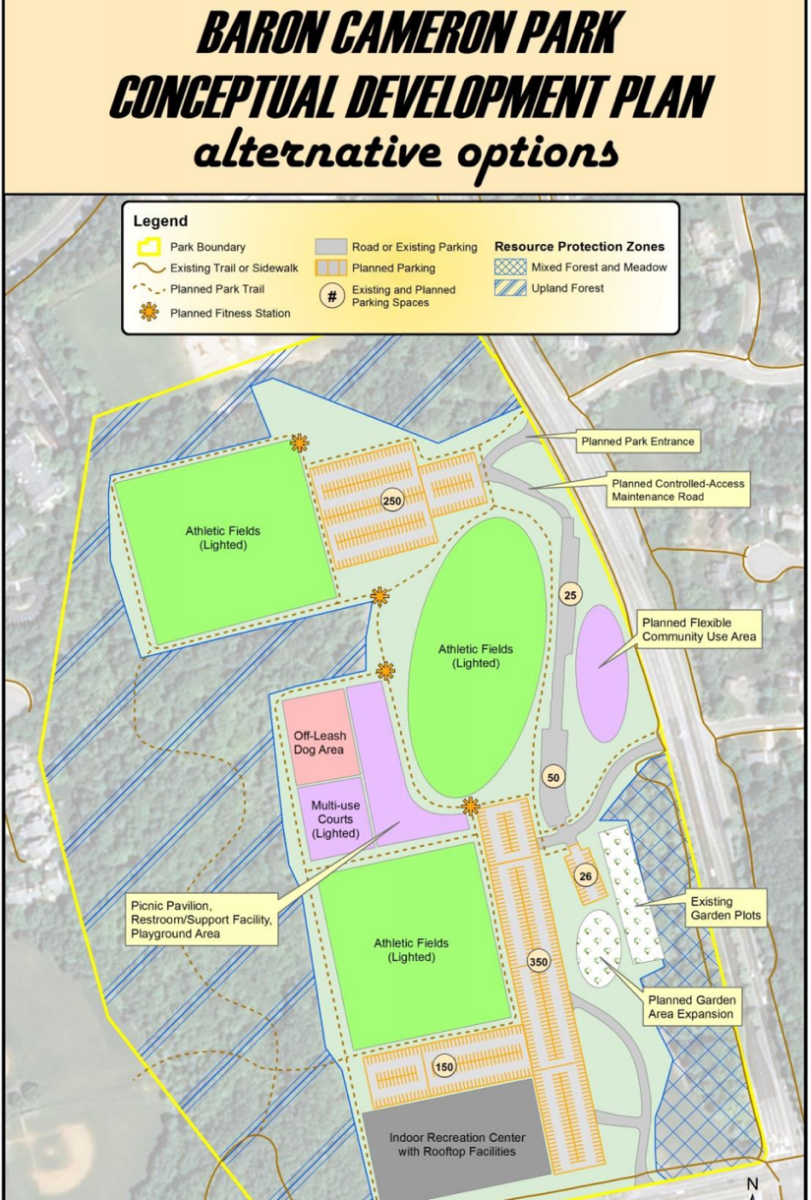
Baron Cameron Park Plan with new dog park location and indoor rec center/Credit: FCPA On the field issue, Terry showed that the plan would actually provide fewer fields than are at the park currently, particularly if part of the land is devoted to a rec center, which is an option in the plan. The Park Authority plans to increase the capacity of the fields by adding artificial turf and lights. Terry showed that with fewer fields, total rectangular field capacity at Baron Cameron would only increase by 20 to 40 percent … and if the rec center is built, it might not increase at all.

Terry briefly discussed the rec center option. As currently envisioned, the Park Authority would supply the land, but would not build the facility (RCC is exploring building a rec center there).Terry expressed Reston 2020′s position that Town Center North would make more sense for a rec center, as that’s where the residents will be.

Terry noted that the draft plan roughly doubles the number of parking spaces and adds a new north entrance along Wiehle. He noted the pluses (reduces the problem of park users parking in surrounding neighborhoods, improved access to the park) and minuses (added congestion on Wiehle, access challenges for the neighborhood next door). He also noted that the new spaces might be tempting for commuters, who might park there and ride the bus to the Wiehle-Reston East Metro station.

The dog park has become one of the most controversial aspects at Baron Cameron. Terry did a good job explaining both sides, both the dog owners who treasure it as a recreational and social venue and the neighbors who have complained about the noise it generates. He laid out possible options: keeping the dog park as is, moving it to the interior of the park (a plan option), or moving it to another location, such as Lake Fairfax Park.

After that, we broke into small groups for discussion.  My table contained a nice cross-section of the community.  Some of our folks lived across the street from the park; others lived on the other side of town. Some had been Restonians for decades; others were relative newcomers. Some had followed the process closely; others came primarily to learn.

Given the diversity of perspectives around the table, it’s no surprise that we had a lively discussion.  We had some good questions and some creative ideas.  When the other tables reported back to the larger group, it was clear that they’d also had great discussions. There was no invective, no shouting; just thoughtful citizens sharing their views and raising honest questions. It was exactly the kind of forum we hoped to create.

After the tables had shared their feedback, we gave every audience member a few sticky dots to identify the points that mattered most to them. When we totaled up the dots, it was clear what the community likes and doesn’t like about the plan.

The respondents liked the increased field capacity, the addition of trails and fitness stations, the retention of the existing gardens, and the planned multi-use courts. They didn’t like the amount of added parking, the potential added traffic on Wiehle, and the insufficient space dedicated to group social activities  They expressed strong opposition to a rec center at Baron Cameron.  And they mentioned some things to add, like bike storage, a circumferential trail, and a Memorial Garden.

If one concern predominated, it was that the plan tries to do too much in too little space. Unfortunately, we’re likely to hear this concern more often as Reston grows. We’re an active community; kids and adults alike are involved in running, biking, sports leagues, and other recreational activities. The demand for recreational amenities is going to rise — sharply — as Reston’s population increases.

But the available space for those amenities is likely to shrink.  Meeting increased demand for recreation in a limited space, and with limited financial resources, will be a major challenge for our leaders to meet in the coming years.  We’ll need to be smart in identifying our priorities, and creative in finding and implementing solutions.

What’s next? We’re compiling the feedback from the meeting into a community response, which we will submit to the Park Authority. We will highlight the most important issues that the community identified, along with recommendations based on them.  But we will also include all the feedback we received, to ensure that everyone’s voice is represented in our report.

I believe our inaugural ResTown Hall Meeting was a success. I look forward to this being the first of many such meetings. I hope to see you at the next one.  And whether you attended this one or not, I hope you’ll share your comments with the Park Authority at Parkmail@fairfaxcounty.gov (deadline for public comments is April 27).  In order to make the best decisions for our community, the Park Authority needs to hear from our citizens.

Colin Mills is the president of Reston Citizens Association. He writes weekly on Reston Now.