Planned Sully District Council of Citizens Associations Testimony on zMOD2
Reston Spring

Reston Spring
Showing posts with label Planning Commission. Show all posts
Showing posts with label Planning Commission. Show all posts
Wednesday, May 3, 2023


Tuesday, July 30, 2019
A Brief Look at Fairfax County Efforts to Reduce Residents' Participation in Land Use Planning & Approval Decisions
As we pass through the pre-election doldrums of the Fairfax
County Board of Supervisors, we should all understand that both the current and
the prospective County Board are in the process of reducing our involvement in
critical land use decisions from community planning to project approval
consideration. We don’t yet know if Democratic
Board candidate Walter Alcorn, almost certainly Hunter Mill District’s next
supervisor, will be swept up in this drive despite his campaign commitment to
involve the community. (His website promises to “Engage
the Community to Plan and Approve Projects that Make Sense.”)
This drive to accelerate county land use decisions in part
by reducing public involvement began with Board of Supervisors Chairman Sharon
Bulova. The Board’s frenzy for rapid,
unfettered urban development goes back to at least 2012. In a report on a February 2012 Board retreat,
the Washington
Post noted,
“County
officials outlined the need to rewrite the rules that govern land-use decisions,
an effort backed by Bulova. She said that the current process, which allows for
intense deliberation and wide public involvement, was better suited to the days
when much of the county was farmland.
Today,
Bulova said, Fairfax is a more urban and densely populated suburb and requires
a more flexible approach that encourages redevelopment, particularly in areas
targeted for intense growth, but preserves public engagement.”
“Preserves public engagement” is what one calls lip service
that meets the legally required minimum public involvement in land use
decisions.
With that encouragement, the Board proceeded “to rewrite the
rules that govern land-use decisions.”
So far, the county has made the following changes:
Fairfax Forward. This Board planning initiative began shortly
after the Board’s retreat. The
initiative aimed to correct what was viewed as a too rigid parcel-specific
development nominations process that only marginally involved the
community.
Yet, as the
Annandale blog reported, “A staff report on Fairfax Forward issued in
February (2013) ‘was disturbingly silent on several critical avenues of citizen
and community involvement in reviewing land use proposals,’ states (the
Providence District Council) PDC’s
comments. “Without amended language to ensure full and meaningful community
review, PDC fears that Fairfax Forward could be construed in a way that
reduces, rather than expands, community involvement in charting Fairfax’s
future.” In 2016, the county
staff acknowledged, “(o)utstanding questions about community participation
in (the) process,” but claimed the new system provided a “(c)learer process for
citizen participation.” No changes to
improve opportunities for community involvement were added.
“Minor Modifications”. In its first step, the Department of Planning and Zoning (DPZ) developed a
“streamlined” process for handling “minor” changes in zoning decisions that
the Board approved in 2017. From a
resident’s perspective, there are several points that stand out:
- There is no requirement that the county notify the community or even adjoining property owners about proposed zoning changes, only the district supervisor.
- There is no Planning Commission review, much less a public hearing, on the proposed changes, only a staff review.
- In the Reston Planned Residential Community (PRC), the Board of Supervisors may approve, without a public hearing, proposed development changes, including dropping recreation uses to the minimum legally required, eliminating “ineffective or obsolete” technological or service proffers (Why would a developer proffer “ineffective or obsolete” technology or services—and why would the county accept them?), and changing architectural design.
All these changes are not supposed to “materially affect”
the proposed development, but, of course, there is no definition of “materially
affect?”
In short, the community is cut out of any opportunity for
contribution to—even of knowledge of-- potentially important changes in a
standing zoning decision concerning the development of a Reston property. Anything done without full public scrutiny is
incredibly dangerous.
The
2016 Gartner Report. To bolster
its Fairfax Forward initiative, the Board engaged yet another consultant in
2015, Gartner Group, to conduct “an independent review of current procedures
and processes, effectiveness and efficiencies to identify opportunities for
improvement which can further customer service and improve operational
execution.” The “customers” are “land
use development customers, from home owners to large-scale developers.” There is little room for residents or
communities, who comprise more than one million people and hundreds of
thousands of homeowners, in the considerations of this report.
Gartner’s final report is all about achieving Goal #3 of the
county’s
2015 strategic economic development plan:
“Improve the speed, consistency,
and predictability of the Development Review Process.” Nothing in the report considers the impact of
the plans—whether community or specific development plans--on the communities
in which the development is to occur. Moreover,
the proposed processes pay only lip service to public participation, limiting them
to state-mandated requirements and the minimal limits of political
propriety.
zMOD Zoning Ordinance
Re-write. And then came “zMod,” the county’s ongoing
process to re-write the county’s zoning ordinances. The major assignment
Clarion Group is tackling is a complete re-write of the county’s zoning
ordinance, including streamlining processes, without making substantive changes in the ordinance. Clarion presented its
first draft of the substance of the proposed re-write on July 1, 2019. There are, in fact, substantive changes laid
out in the draft’s summary covering accessory uses, electrical vehicle
charging, and much more. (We strongly
encourage you to read at least the summary of this draft report where the key
changes are outlined.) On the other
hand, there is no discussion of the process by which one legislates changes
to that ordinance, including the role of public input.
Among the changes permitted in PRCs, including Reston, the
zMOD draft newly permits new “live-work development” and “stacked townhouse”
uses and excludes “community swim,
tennis, and other recreational uses.” These beg questions regarding what the
DRB will think of stacked townhouses and the future of that county regional
recreation center that is supposed to be built in Reston. Also, the proposal to not allow recreational
facilities puts Reston’s two golf courses
in jeopardy. Certainly there will be
much more to come, and we doubt that much of it will be to Reston’s advantage
or promote its residents’ involvement.
It is vital that all Reston residents understand the
proposed PRC zoning ordinance changes and their implications for our
community. There is much to be concerned
about. More broadly, we need to
understand what changes, if any, are on the docket for the process for
developing, vetting, and approving PRC zoning changes. It was only because of a huge community
effort involving literally hundreds, even thousands, of Restonians that we were
able to postpone indefinitely consideration of the recent Reston PRC zoning
ordinance amendment that would have allowed unconscionable increases in our
population.
One encouraging sign is that activists from all over the
county are now organizing. Citizens from
ALL Fairfax County districts are becoming increasingly alarmed at the county’s
rush to approve development everywhere with reduced citizen review. The 2016 Gartner report has been read and
raises huge concerns. It seems to be THE
blueprint designed for and by developers at the expense of true public input.
Any county effort to reduce community involvement in the
zoning amendment process will only make it that much more difficult for us to
stop truly bad county decisions that would undermine the goals and principles
of our master planned community.
Friday, March 1, 2019
"The 'hurrier' Fairfax County goes, the 'behinder' it gets," Letter to the Editor, Fairfax Times, March 1, 2019
The hurrier Fairfax County goes, the behinder it gets.
A comment by a “guest” in a
recent RestonNow article on the Planning Commission hearing on the PRC
zoning issue that, “We can't slow down development AND we can't speed up
providing the associated infrastructure,” was stunning and highly accurate. It reminded me of the White Rabbit’s comment
in Lewis Carroll’s Alice in Wonderland, “The hurrier I go, the behinder
I get.”
And, yes, that’s what happening
across areas of growth in Fairfax County, not just Reston. It describes the poor decision making of the
County Board that keeps approving residential development while being unwilling
to provide the necessary supporting infrastructure from sidewalks to schools. The result, of course, is the declining
quality of life throughout our county, especially in faster growing communities
like Reston.
County officials, including the
Planning Commission, attribute this behavior to Virginia’s nefarious state
Supreme Court “Dillon Rule” decision. In
brief, the Dillon Rule assumes all local governments are corrupt and,
therefore, prevents them from making any decisions not explicitly permitted by
the state legislature. Development
moratoriums and stiff proffers are, according to Fairfax County officials, not
among those authorities.
So we are stuck with a county
government—planning staff, Planning Commission, and Board of Supervisors--that
believes it must approve virtually all development proposals presented to it with
no promise of timely commensurate infrastructure availability. Otherwise, they risk the wrath of a developer
law suit, they say. And to say that Fairfax
County is law suit risk averse is a massive understatement.
The result is, as we are seeing
in Reston, growth continues unabated while the supporting infrastructure is
deferred…and delayed…and postponed because of a lack of funding or the means to
acquire it. Indeed, the state
legislature—under great developer pressure and even greater financial contributions—has
taken steps in recent years to restrict further what local governments can do
to generate proffers and other infrastructure commitments from developers.
This occurs, as
I pointed out in a previous RestonNow op-ed, because residential
development requires more community services (schools, rec centers, libraries, parks,
etc.) to sustain a given quality of life than commercial development. Both require streets, water and sewage,
public safety, and other services, but residents require more.
In fact, multiple studies, including
a “meta-analysis”
of more than one hundred community studies, have shown the cost of
community services for residential development almost universally exceeds the
tax revenues (property, sales, etc.) that development generates. Normally, that tax revenue deficit is between
10%-20%. On the other hand, tax revenues
generated on commercial and agricultural development, on average, more than
doubles the cost of services they require.
Nonetheless, senior county staff
has denied to me personally that this will be true in Reston—and presumably the
remainder of the county—without any explanation. They say, “Trust us.” Right!
There is only one possible outcome
from this county self-deception: The quality of life in Reston and other
rapidly growing residential communities in Fairfax County will continue to
decline as the demand for resources to support needed infrastructure for residents
increasingly distances the supply. We are already seeing minimum two-decade lead
times for key infrastructure development (such as the Soapstone overpass) as
our needed schools, streets, libraries, recreation centers, etc., remain
unfunded. In Reston’s case, we face the worst-case
scenario in which we may even lose existing referendum-approved bond funding
for a new library in the face of county bungling in getting it built.
In short: The hurrier we go, the behinder we get.
The next step in the battle to
bring some reason to the growth-infrastructure balance in Reston is to oppose
the pending Reston PRC (our suburban areas plus parts of Town Center) zoning
ordinance amendment that would increase allowable residential density from
81,000 to 94,000 people—not counting affordable housing and related “bonus”
market units that could raise that number to 113,000 people or more—doubling all of Reston’s current population. That’s on top of the plan potential for 91,000
residents in the PRM-zoned areas covering most of Reston’s Metro station areas.
This call for allowing additional
density comes at a time when the county
puts Reston’s 2018 population at a mere 63,774. What’s
the rush?
We all need to take two actions:
- Write the Board of Supervisors (clerktothebos@fairfaxcounty.gov) and express your concern over the proposed increase in the Reston PRC allowable density. Writing to Supervisor Hudgins will not help: She is the principal advocate for the density increase.
- Attend the March 5, 2019, Board of Supervisors hearing on the proposed PRC zoning amendment that begins at 4:30PM in the government center auditorium. And wear your YELLOW shirt supporting Reston if you have one. (You may buy one from Reclaim Reston at the government center before the hearing if you wish.) Note: This will probably be a long meeting with other hearings on the agenda as well.
We need everyone to help in
bringing some coherence into our Reston development process, and maybe set an
example for good development management in the rest of the county. After all, we are one of the world’s premier
planned communities. Let’s not lose that community prominence
because of county incompetence.
Terry Maynard
Reston
Thursday, January 31, 2019
"What's the number?" E-mail to Planning Commission and Board of Supervisors by Terry Maynard, January 29, 2019
Dear Commissioners and Supervisors,
In
the January 23rd Planning Commission hearing on increasing the density
cap in Reston's PRC from 13 to some higher number, Mr. Hart asked the
critical question, "What's the number?" If not 13 people per acre, then
what should it be? From my perspective, the number for the population
cap in the
Reston PRC is, and should remain indefinitely, 13 persons per acre.
If the Reston PRC overall P/A number is increased, even a little,
it destroys the basis for it being fixed at any level as part of our founder’s
vision and a true master plan. In so
doing, it extinguishes the core foundation of Reston as a planned community
with a well-considered balance between residents, jobs, open space, and
infrastructure. Instead, the community
and the county would just keep chasing the population cap higher or abolish it
all together as property owners continue to seek to add density. It does nothing for jobs, open space, or
infrastructure (as many Reston speakers highlighted at the recent hearing). Planned community destroyed.
It seems clear to me that Bob Simon fully appreciated that Reston would have mass transit in the Dulles Corridor in addition to the access road and toll road. With that in mind, a 1990s version of the Reston Master Plan stated that the maximum (not “target”) population of Reston is 130,000 people. (That map is no longer publicly available.) This is consistent with the story presented by Mark Looney at the Planning Commission hearing, and just because the result was a simple equation doesn’t mean it was not well considered. For example, how about E = mc2? Simple, but with huge implications—and it took years to formulate. Not surprisingly, with an overall Reston acreage of about 10,000 acres, that 130,000 population cap works out to 13 people per acre.
His logic, as reported in A Brief History of Reston, Virginia
(Gulf Reston, 1970, p. 11) was: "Our present zoning ordinances (which isolated land uses) are
largely responsible for the diffusion of our communities into separate,
unrelated hunks without focus, identity or community life. They have helped
produce chaos on our highways, monotony in our subdivisions, ugliness in our
shopping centers. They are to blame for the whole neon-lighted wasteland that
exists." And, yes, neon lights have
appeared on Comstock’s new office building at Reston Station. He was more prescient than could have been
imagined.
The Reston Master Plan as approved by
the Board of Supervisors in 2014 (Phase 1 TSA revisions) came close to defining
that 130,000 limit.
It targeted the development of 28,000 dwelling units (DUs) in the TSAs, about 59,000 people.
The largely suburban PRC areas of Reston would top out at about 82,000 people at 13 p/a less the overlap between the PRC and TSA in Reston Town Center comprising about 11,000 DUs, or about 23,000 people. (My best estimate of the current RTC PRC population is about 13,000 people in some 6,300 DUs. This is based on Fairfax County and RA data.)Netting that all out (59,000 TSA + 59,000 non-TSA) leads to a potential Reston population of 118,000 people in “One Reston,” approaching the cap laid out in the Reston Master Plan some two decades ago. And it would allow a virtual doubling of Reston’s current population (which the US Census estimates at 60,352 in its 2012-2017 ACS survey) in four decades that it has taken well over five decades to achieve. Our experience shows that that is certainly enough growth to try to manage in any master plan, zoning ordinance, or supporting budget.
Some of the further implications of
that calculation are:
We need to “down plan” the target residential potential of the TSAs from 44,000 DUs (2015 plan amendment) to 28,000 DUs (2014 Phase 1 plan approval). This was the total number of DUs developed by the Phase 1 Reston Master Plan Task Force for Reston’s station areas.
We should not change the number of development categories in the PRC zoning ordinance (low, medium, high) or their values (maximum of 50 DU/A for MF DUs). As RA has pointed out, only one development application has so far exceeded that density limit. There should be no more.
It is clear, as members of the Planning Commission have stated, that we need to re-connect the Reston plan with the PRC zoning ordinance before considering changes to the latter. With the next scheduled Reston plan effort set for 2020, I think the Planning Commission has the time to lay the groundwork for that effort before moving forward on this zoning amendment. My only “ask” is that the new effort must include a strong community voice—people representing Reston residents’ interests—in the re-shaping of our community plan and zoning.Village centers should be re-developed at not more than a moderate density (30 DUA), not the 50 DUA proposed in the current PRC zoning amendment proposal. In this manner, they would remain "neighborhood serving" as called for in the Reston Master Plan rather than just high-density annexes isolated from the transit station areas.
In the meantime, I think the
Hippocratic Oath applies to the Reston body politic as much as it applies to
the body human: “First, do no harm.”
Thank you for your consideration—and
your patience,
Terry Maynard
Photo: Yellow-shirt Restonians flood the Planning Commission hearing on the proposed PRC zoning amendment, January 23, 2019
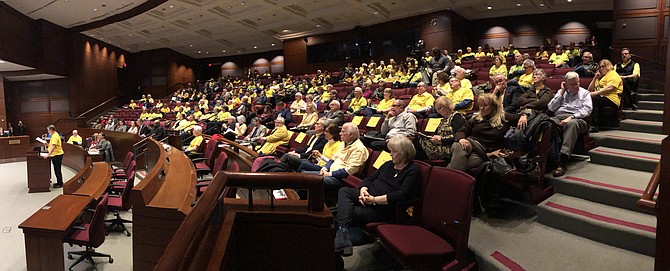 |
| Photo by Mercia Hobson, Reston Connection, January 30, 2019 |
Monday, January 7, 2019
Rise up, Reston! Stop the Reston PRC density increase!
All Restonians who wish to preserve Reston as a well-planned
and executed planned community must rise up now and express their disgust with
the county’s proposal to increase the allowable density, potentially tripling “ONE
Reston’s” population.
On January 23, the county Planning Commission will be
considering an amendment to Reston’s Planned Residential Community (PRC) zoning
category to increase the allowable density from 13 to 15 persons per acre. The zoning ordinance covers Reston’s suburban
areas, including the village centers and most of Reston Town Center. While that increase sounds relatively modest,
it does NOT consider:
- At present, the Reston PRC’s density is about 18,000 people (more than 20%) below its allowable capacity of more than 81,000 people. Reston’s growth over its lifetime, virtually all in the PRC area to date, has averaged less than 1,000 people per year.
- Up to a 20 percent “bonus” to developers for building affordable (low- and middle-income) housing that is not counted per the PRC zoning ordinance, adding capacity for another 7,400 people to live in the PRC area.
- Existing plans and zoning authority to build 40,000 new high-rise, multi-family housing units (84,000 added people) in Reston’s three transit station areas (TSAs) beyond the PRC boundaries, but affecting everyone in Reston and beyond.
All in all, these changes would allow an increase Reston’s
population from about 63,000 to about 190,000 people in ONE Reston.
At the same time, the county has not funded plans to meet
Reston’s transportation, school, park, and other needs associated with this
growth, even as required by its own county policies. In fact, the Fairfax
schools just rejected funding again for a new high school to meet the
growing needs along the Dulles Corridor.
Yet that hasn’t stopped the county from placing
another tax on Reston homeowners in the transit station areas for the “grid
of streets” that only helps developers complete their projects more profitably.
The result of this massive unplanned imbalance between
growth and infrastructure will be a dramatic loss of quality of life in Reston
for everyone, new or longtime resident.
In the process of moving forward, the county
and our supervisor have reneged on their explicit commitment to the
community to follow through with community-county staff meetings to address the
surrounding the proposed Reston density increase before proceeding with
legislative steps. Their disrespect for
Reston and Restonians is profound. They
see Reston as a plantation that they own and will oversee as they wish with no
regard for its residents or their needs.
The Coalition for a Planned Reston (CPR)
has detailed a list of ten reasons to keep the Reston PRC density cap at 13
persons per acre that includes the above and other reasons NOT to increase
the density cap.
While CPR and RA are planning to testify at the Planning
Commission hearing, individual Restonians must rise up to stop this
authoritarian county behavior. Attend
the Planning Commission hearing at 7PM, January 23, in the government center
auditorium. Wear your YELLOW shirt.
Bear witness, speak out, and demand that the county meet the
community’s needs as well as its own politically-driven agenda. This may be your last chance to preserve the
planned Reston we have known for more than a half century while allowing for
reasonable future growth. We need to
fill the Fairfax County Government Center auditorium (12000 Government Center
Parkway) with hundreds of YELLOW-shirted Restonians to have a chance to stop
the county’s effort to ram this amendment through.
Subscribe to:
Posts (Atom)