Reston Spring

Reston Spring
Showing posts with label reston. Show all posts
Showing posts with label reston. Show all posts
Sunday, October 29, 2023


Friday, October 27, 2023
Opinion: A Casino in Reston? Hell NO!
Opinion: A Casino in Reston? Hell NO!
Lynne Mulston of Citizens Opposed to Reston Casino calls on all residents of Reston to join their efforts to stop Comstock's casino plans.


This opinion piece was submitted to Patch by Lynne Mulston, the campaign coordinator for Citizens Opposed to Reston Casino.
Nothing
coalesces Reston like outside legislators trying to force a bad idea
onto our community. For the past month the Reston community has been
rallying and uniting in their opposition to the idea of . . . wait for
it . . . a casino at the Wiehle-Reston East Metro Station.
A bill to establish a casino on the Silver Line was introduced in January 2023 by State Senator David Marsden (D-Burke) and Delegate Wren Williams (R-Stuart). Thankfully it was withdrawn, but only because of the forceful advocacy of Reston’s local representatives State Senators Janet Howell and Jennifer Boysko.
So why all the attention now? Well two things have happened. Through interviews with legislators and campaign finance reporting, the Patch uncovered that all roads point to the developer of the Wiehle-Reston East Metro Station, Comstock Holding Companies Inc (NASDAQ: CHCI), as the political money and lobbying force behind this legislation. And earlier this month, Senator Marsden and Delegate Williams indicated their intent to re-introduce the legislation.
The idea of a Reston casino is opposed by our local elected officials, including Hunter Mill District Supervisor Walter Alcorn, State Senator Jennifer Boysko, State Senator Janet Howell, Delegate Ken Plum, and At-Large School Board Member and candidate for Delegate Karen Keys-Gamarra.
Additionally, the Reston Association Board, which is elected by its 63,000 members, issued a statement of opposition calling upon State Senator Marsden to ‘cease all further efforts toward this end immediately.’ Reston Association added, “If you are determined to reintroduce SB 1543 or a similar bill, the Association Board of Directors demands that such legislation exclude that area within the Reston Master Plan or the area with the Reston Census Designated Place as defined by the U.S. Census from the eligible sites under consideration for a casino.”
But in interviews and public engagements, the legislation’s sponsors insist on pushing on.
They would have us believe this legislation is actually intended for Tysons. They would have us believe this is “not a casino bill, but is a referendum bill.”
It’s time we tell them a little bit about the people in Reston.
First, we know how to read a bill. And this bill does not limit the casino location to Tysons. Rather it opens it up to nearly every stop on the Silver Line in Fairfax County, including Reston. If they really intended this for Tysons, they could have written it that way.
Second, we know publicly traded companies don’t raise and spend hundreds of thousands of dollars in political contributions to pass legislation they don’t intend to use. The Patch has tracked how Comstock-related companies, its employees, and individuals it does business with have contributed directly to the bill sponsors and also funded a new political action committee to target even more.
Third, we can do math. There is a casino referendum in Richmond, and the side supporting the casino is spending more than $8 million this year alone. There are only 158,131 voters in Richmond. If a Reston casino goes to a referendum in Fairfax County, we have 784,282 voters in the county. We know the math here. This is going to be a massive and incredibly expensive campaign for our community to fight against.
Finally, we are a planned community, and an entertainment district with a casino is not in line with the community's vision for the future of Reston. Over the past three years, thirty members of our community, including representatives from developers, worked with County staff, interest groups, and the public to craft a Comprehensive Plan for the next decade of Reston's growth. In the community's plan that was approved by the Fairfax County Board of Supervisors, the Wiehle Metro Station area is envisioned to be an urban neighborhood with encouragement for higher education, research and development, and tech uses. A casino would drastically change the vision for Reston.
Mr. Marsden and Mr. Williams, now that you know more about us, it’s time to be transparent.
To others, such as Fairfax Board of Supervisors Jeff McKay, who recently tried to “reassure” the county by stating “[t]here is no proposal on the table” and “[t]here is no bill that anyone has seen," — Mr. McKay, there is nothing reassuring about this. Now is the time to take a stance as bills are being drafted and negotiated for the new session. You know this.
And to our neighbors and friends, we hope you will join us. The Reston Citizens Association, Reston Strong, Rescue Reston, Reston 2020, and Save Our Sunrise have joined together to start Citizens Opposed to Reston Casino (CORC). Go to CORC's website and sign up for the email updates and sign the change.org petition.
Together, we can amplify our voices in opposition to a casino in Reston.
Saturday, January 19, 2019

Tuesday, April 19, 2016
Op-Ed: Reston Transportation Tax Proposal is Grotesque County Corporate Welfare, RestonNow, April 18, 2016
The following is a re-post from RestonNow.
 Restonians are once again faced with the prospect of the burden of an added local “tax service district that
could add hundreds of dollars to their annual property tax bill every
year. The one we already have, Small Tax District 5, supports our Reston
Community Center in providing cultural and educational activities for
the community. The proposed new one would solely subsidize developer
profits while increasing county tax revenues.
Restonians are once again faced with the prospect of the burden of an added local “tax service district that
could add hundreds of dollars to their annual property tax bill every
year. The one we already have, Small Tax District 5, supports our Reston
Community Center in providing cultural and educational activities for
the community. The proposed new one would solely subsidize developer
profits while increasing county tax revenues.
As this discussion continues, Reston Association has shared a questionnaire online with its weekly RA NewsLine (click on “Transportation Tax Survey) for residents to provide feedback on the Reston special transportation tax district idea. I urge all Restonians to vote “NO.” The following provides an explanation why.
The basis for the proposal lies in planned development in Reston’s station areas, growth that will exclusively benefit Reston’s station area landowners. Assuming that all Reston developers are as successful as Boston Properties per its 2015 annual report, their likely profit will total more than $53 billion over 40 years after building costs. That includes more than $9 billion from their future development as well as more than one billion dollars per year from their existing Reston holdings. That is an average of $1.3 billion per year!
Yet these same developers, backed by the County, want Reston homeowners to pick up as much as half of the $2.6 billion tab — about $65 million per year — for needed station area road improvement even though their total cost will be less than three percent of their profit from their Reston properties over the next 40 years.
The forecast annual road improvement cost is less than five percent of the future annual profits of the Reston station area landowners and can be easily absorbed as part of their investment in offsetting the impact of their development, but the County is proposing that residents pay some of the road costs.
One of the transportation tax options the County has proposed is that all Reston homeowners pay $.025/$100 residential property valuation to help defray the road improvement costs. Today, with the average Reston home valued at $428,000, the added cost of that Reston special tax would be $107 per year to start. This special tax would be in addition to the average $202 Restonians already pay to operate the Reston Community Center, a County public facility committed primarily to Restonians’ use.
With 3 percent annual appreciation in the value of a family home and/or general inflation, the average added transportation tax cost would be more than $200 per year per household over the next 40 years for an average-priced home — assuming the mix of home values remains constant (and it is more likely to increase with thousands of new high-priced condos in the station areas). On a community-wide basis, that three percent annual growth in assessments would mean the average Reston homeowner would pay more than $8,800 and the total residential community tax contribution would be more than $350 million over 40 years. And that is without any shift in housing mix or tax rate increases by the Board of Supervisors.
The Board is driving the transportation tax idea because it believes that by encouraging the growth of taxable real estate values, it can solve its budget problem. Another Reston special tax district at $.025/$100 valuation Reston-wide tax rate would bring in about $4.4 million in new revenues in the first year — and grow every year thereafter — even if there is no development. Moreover, from the Board’s perspective, to the extent these taxes encourage developers to build sooner because of lower investment costs, it will create even more high-tax value high-density real estate. It’s a win-win situation from a Board perspective: More tax revenue through subsidized corporate development.
And all of that special Reston tax money would go to Reston’s station area landowners in defraying the road infrastructure costs of their for-profit development. Specifically, the taxes would be used to improve roads that go to, from, within, and through the station areas to serve developer properties that would be required for their profitable high-density development. Yet–
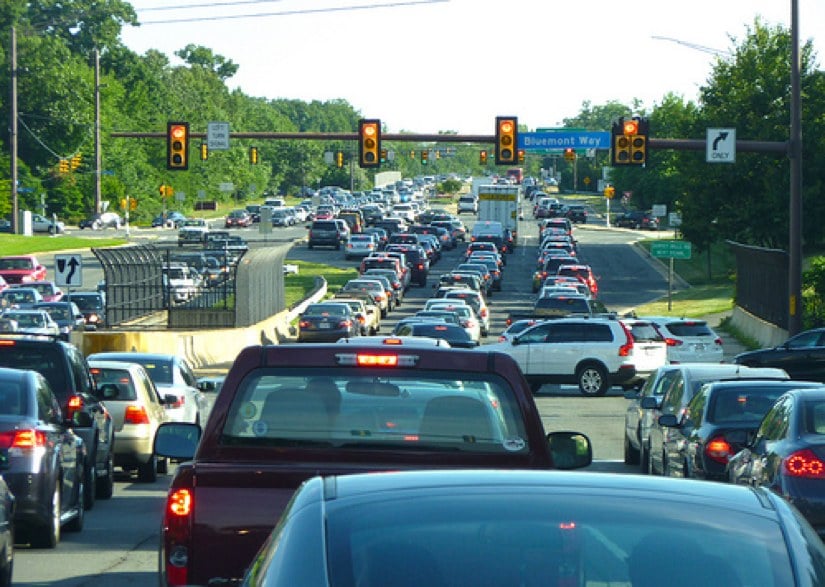
The ultimate irony of this road “improvement” tax proposal is that the County literally promises worse congestion as a desirable traffic “goal.” So Restonians will be taxed to experience worse congestion, even those who only drive through the station areas, say, on Wiehle to/from the Dulles Toll Road, with no intention of visiting them.
The bottom line is that the transportation tax proposal completely detaches who pays the tax from who benefits from it. Residents pay more for less usable roadways; developers pay less and profit more. It is unfair and inequitable to Restonians by any measure.
The idea that taxing Reston homeowners, whether they live in the station areas or beyond, because they will garner some unidentified, much less quantifiable, “benefit” from the development there is a deceptive scheme and the County knows it. The proposed County transportation tax is, in fact, nothing more than grotesque corporate welfare, the Reston property owner paying more taxes so major Reston developers can increase their profits and the County can increase its tax revenues.
The transportation tax idea should be opposed vigorously by the Reston community, the RA Board of Directors and other community leaders and organizations, the County-appointed RNAG advisory group examining Reston’s transportation options, and ultimately the Board of Supervisors itself. Do what you can now:
Terry Maynard
Reston
Op-Ed: Reston Transportation Tax Proposal is Grotesque County Corporate Welfare
This is an op-ed by Reston resident Terry Maynard. It does not reflect the opinion of Reston Now. Something on your mind? Send a letter to news@restonnow.com.Restonians are once again faced with the prospect of the burden of an added local “tax service district that
could add hundreds of dollars to their annual property tax bill every
year. The one we already have, Small Tax District 5, supports our Reston
Community Center in providing cultural and educational activities for
the community. The proposed new one would solely subsidize developer
profits while increasing county tax revenues.As this discussion continues, Reston Association has shared a questionnaire online with its weekly RA NewsLine (click on “Transportation Tax Survey) for residents to provide feedback on the Reston special transportation tax district idea. I urge all Restonians to vote “NO.” The following provides an explanation why.
The basis for the proposal lies in planned development in Reston’s station areas, growth that will exclusively benefit Reston’s station area landowners. Assuming that all Reston developers are as successful as Boston Properties per its 2015 annual report, their likely profit will total more than $53 billion over 40 years after building costs. That includes more than $9 billion from their future development as well as more than one billion dollars per year from their existing Reston holdings. That is an average of $1.3 billion per year!
Yet these same developers, backed by the County, want Reston homeowners to pick up as much as half of the $2.6 billion tab — about $65 million per year — for needed station area road improvement even though their total cost will be less than three percent of their profit from their Reston properties over the next 40 years.
The forecast annual road improvement cost is less than five percent of the future annual profits of the Reston station area landowners and can be easily absorbed as part of their investment in offsetting the impact of their development, but the County is proposing that residents pay some of the road costs.
One of the transportation tax options the County has proposed is that all Reston homeowners pay $.025/$100 residential property valuation to help defray the road improvement costs. Today, with the average Reston home valued at $428,000, the added cost of that Reston special tax would be $107 per year to start. This special tax would be in addition to the average $202 Restonians already pay to operate the Reston Community Center, a County public facility committed primarily to Restonians’ use.
With 3 percent annual appreciation in the value of a family home and/or general inflation, the average added transportation tax cost would be more than $200 per year per household over the next 40 years for an average-priced home — assuming the mix of home values remains constant (and it is more likely to increase with thousands of new high-priced condos in the station areas). On a community-wide basis, that three percent annual growth in assessments would mean the average Reston homeowner would pay more than $8,800 and the total residential community tax contribution would be more than $350 million over 40 years. And that is without any shift in housing mix or tax rate increases by the Board of Supervisors.
The Board is driving the transportation tax idea because it believes that by encouraging the growth of taxable real estate values, it can solve its budget problem. Another Reston special tax district at $.025/$100 valuation Reston-wide tax rate would bring in about $4.4 million in new revenues in the first year — and grow every year thereafter — even if there is no development. Moreover, from the Board’s perspective, to the extent these taxes encourage developers to build sooner because of lower investment costs, it will create even more high-tax value high-density real estate. It’s a win-win situation from a Board perspective: More tax revenue through subsidized corporate development.
And all of that special Reston tax money would go to Reston’s station area landowners in defraying the road infrastructure costs of their for-profit development. Specifically, the taxes would be used to improve roads that go to, from, within, and through the station areas to serve developer properties that would be required for their profitable high-density development. Yet–
- If the developers believe they will earn an adequate return on their investment, they will build the roads needed to help make their new construction profitable anyway without a special Reston residential tax subsidy.
- If they choose not to build for whatever reason, then Reston won’t need improved roadways (except to meet existing standards) and, therefore, we won’t need any added transportation taxes.
The ultimate irony of this road “improvement” tax proposal is that the County literally promises worse congestion as a desirable traffic “goal.” So Restonians will be taxed to experience worse congestion, even those who only drive through the station areas, say, on Wiehle to/from the Dulles Toll Road, with no intention of visiting them.
The bottom line is that the transportation tax proposal completely detaches who pays the tax from who benefits from it. Residents pay more for less usable roadways; developers pay less and profit more. It is unfair and inequitable to Restonians by any measure.
The idea that taxing Reston homeowners, whether they live in the station areas or beyond, because they will garner some unidentified, much less quantifiable, “benefit” from the development there is a deceptive scheme and the County knows it. The proposed County transportation tax is, in fact, nothing more than grotesque corporate welfare, the Reston property owner paying more taxes so major Reston developers can increase their profits and the County can increase its tax revenues.
The transportation tax idea should be opposed vigorously by the Reston community, the RA Board of Directors and other community leaders and organizations, the County-appointed RNAG advisory group examining Reston’s transportation options, and ultimately the Board of Supervisors itself. Do what you can now:
- Vote “NO” to the transportation tax in RA’s online survey
- Attend Supervisor Hudgins’ “Reston . . . Blueprint for the Future” Open House this Wednesday, April 20, 6-8:30 p.m., South Lakes High School, and tell county officials and developers what you think.
- Let Reston’s leaders know of your disapproval of this dishonest and unfair proposal.
Terry Maynard
Reston
Subscribe to:
Posts (Atom)