Reston Spring

Reston Spring
Reston Spring
Showing posts with label GMU. Show all posts

Tuesday, October 7, 2014

Economist still somewhat downbeat about N.Va. jobs, housing pictures, InsideNOVA

Posted
The U.S. economy continues its recovery from the steep recession of several years ago, but Northern Virginia’s economic prospects are making only anemic progress because of reduced federal spending and replacement of high-paying jobs with ones of lesser earning power.
“There’s nothing driving growth,” lamented Stephen Fuller, director of George Mason University’s Center for Regional Analysis. “There’s nothing dynamic or dramatic. We have lagged.”
Fuller delivered his remarks Aug. 21 at Capital One headquarters in McLean.
The federal economic-stimulus package implemented early in President Obama’s first term strengthened the U.S. economy, Fuller said. Northern Virginia’s unemployment rate of 4.5 percent is well below the 6.1-percent national average, but all the signs are not rosy.
Increased federal spending spared Northern Virginia the full brunt of the recession, but now the U.S. government is cutting back and the local region is feeling the pinch, he said.
“It’s now an albatross,” Fuller said of Northern Virginia’s dependence on federal spending. “It’s not helping a bit.”
The private sector now will have to build upon the region’s unique assets and drive the economy, Fuller said.
“We need to expand our markets and become more competitive,” he said. “We need to know how to compete where we can.”
Four years ago, the Washington region had the nation’s best economic prospects; now it’s on the bottom of the list. The region has lost 21,000 federal jobs since the recession and likely will lose another 20,000 in the next several years, Fuller predicted. . . .
Click here for the rest of this article.  

Please note that this assessment comes from the same GMU center that prepared job and population growth assessments for the Dullles Corridor in the midst of the Great Recession (which it ignored) that guided the Tysons and Reston re-planning efforts.  Those forecasts presented off-the-charts demand-driven economic growth for the next 30 years along the corridor. Apparently, that's not going to happen after all. 

Credibility and consistency are not a strength at developer-funded GMU CRA, including the substantial financial backing of the developer consortium The 2030 Group.

Thursday, August 14, 2014

WMATA notes the importance of residential density near Metro stations to increase ridership.

In a post on its official blog, PlanItMetro,  WMATA makes a point that we made three years ago to the Reston Task Force:  The more residents living near a Metro station, the greater will be Metro ridership.  Here's what WMATA has to say:
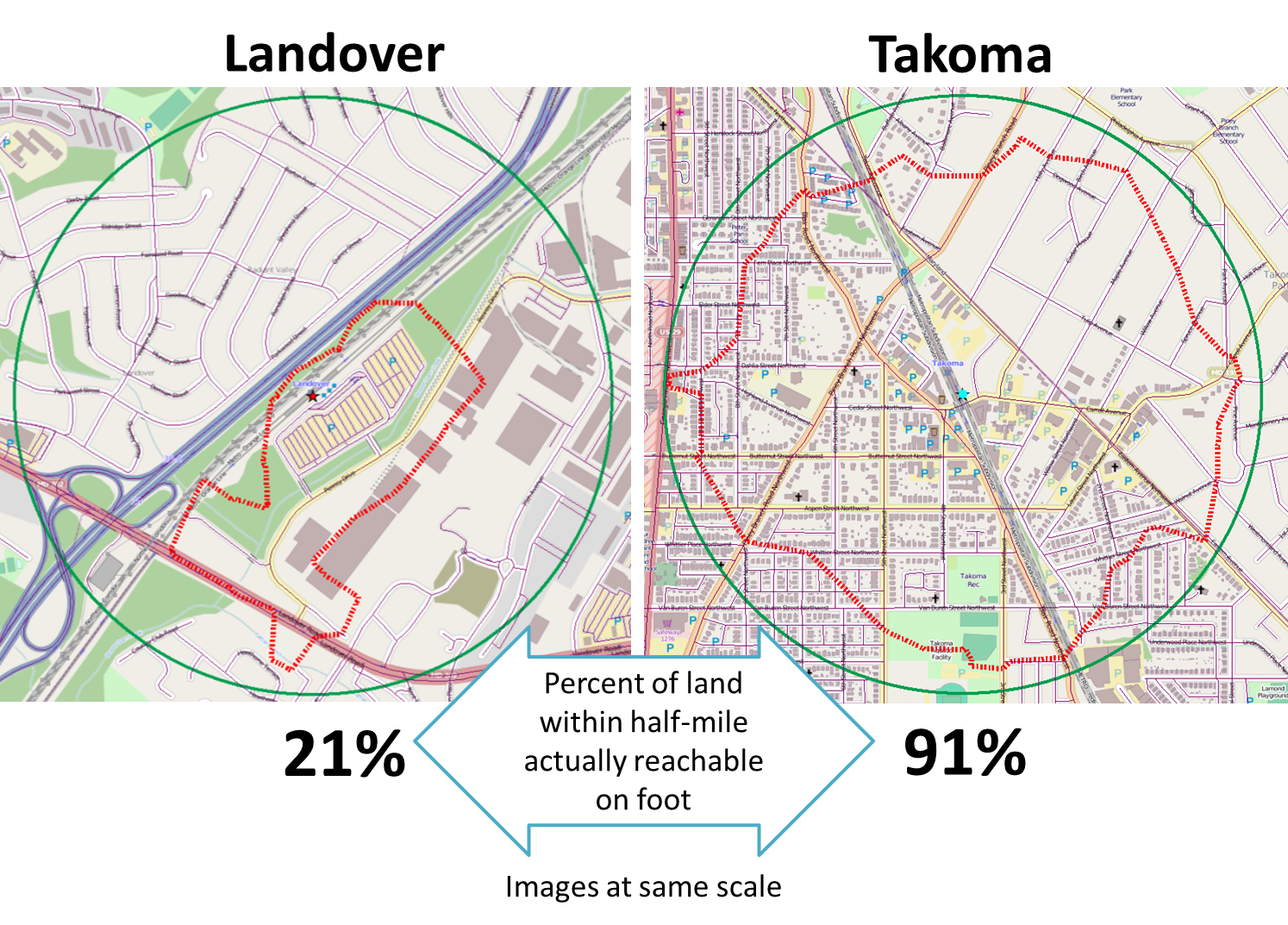
Metro cares about transit walk sheds because more households accessible to transit by walking translates directly into more ridership.
We’ve been focusing a lot on transit walk sheds lately. We’ve shown that the size of a transit walk shed depends heavily on the roadway network and pedestrian infrastructure, and that these sizes vary dramatically by Metrorail station. We’ve also demonstrated that expanding the walkable area can make hundreds of households walkable to transit.
But why do we care so much about walk sheds? Because larger walk sheds mean more households in the walk shed, and that means ridership. For example, we’d be hard pressed to find many households in Landover’s small walk shed, so it’s no surprise that walk ridership at that station is low. On the other hand, thousands of households are within a reasonable walk to Takoma’s larger walk shed, and walk ridership there is much higher.
In other words, the more people can walk to transit, the more people do walk to transit – and data across Metrorail stations prove it:
Correlation between Households in the half-mile walk shed, and AM Peak ridership, by WMATA Metrorail station entrance
More households in the walkable area around a Metrorail station means higher ridership.
The chart above shows that the number of households in a Metrorail station entrance’s walk shed is highly correlated with AM Peak walk ridership at that station.  In fact, the number of households walkable to a Metrorail station alone explains nearly 70% of the variation in walk ridership across Metrorail stations.
Click here to read the rest of this post.

The results and certainly the conclusions are similar to a short, more technical paper we wrote for the Reston Task Force and posted on this blog in 2011 entitled, "The Residential vs. Employment Balance in TOD Areas: Optimizing for Reduced Congestion and Environmental Damage."  The two key graphics in that report show that residents of a Metro station area "walk shed" ("the half-mile circle") are much more likely to use Metro than people who work in that station area.  They also show the converse:  That people who work in a station area are much more prone to drive to that station area at any given distance from the station than are the people who live there.


Our report was based on a 2005 WMATA survey of Metrorail ridership.  Since we are unaware of any more recent such surveys, we suspect the PlanItMetro article is a more fine-grained analysis of the same report.  The results in both these reports is consistent with a significant body of research on the topic:  Residents of a transit station area are much more likely to use transit than workers in the station area. 

Nonetheless, the point received absolutely not attention by the developer-driven task force, which was intent on allowing massive office space development and little residential development, especially within the critical first 1/4 mile of the Metro station.  This was especially true in the Town Center area.  Even advocates for Metrorail on the task force, including its DCRA President chairman, did not grasp--or chose to ignore--the importance of nearby residential development to Metrorail ridership.  The same was true to an even much greater extent in the Tysons Task Force. 

In the end, the County planning staff modestly muted the jobs-to-residential ratio and density (total square footage of allowable developed space) in the final plan subsequently approved by the County Board in the face of traffic analyses that showed even more massive gridlock than we can expect under the approved plan.  The final density, most notably in Reston Town Center, is less than proposed by the task force's Town Center Sub-committee, dominated by Boston Properties and its allies, and a better balance, that is, more residential, than the sub-committee proposed.  Still, the County's analysis of the approved development plan shows that, when the planned development is completed, Restonians can expect five-minute or more traffic delays at each intersection along the key through streets (Reston Parkway, Wiehle) in the station area during peak traffic periods--even if all the planned street infrastructure is in place!

And none of this considers the much reduced--and declining--office space per worker now seen in office property leasing.  Recent trends reported here several times in letters to Board Chairman Sharon Bulova (see here, here, here, and here) show that the office space per worker is being cut by half at least for a variety of reasons, meaning we can anticipate at least twice as many workers in the allowed plan office space than the plan envisions--and about twice as much traffic as has been assessed.

All of this belies the stated goal of Reston Master Plan re-make to take advantage of the arrival of Metrorail since little the task force did actually took advantage of the transit opportunities the arrival of Metrorail presents.  Rather it was about increasing developer and landowner profit opportunities and especially the County's real estate property tax base.  Unfortunately, the turn in the economy and the reduction of federal spending has shown all the growth assumptions prepared by developer-funded GMU's Center for Regional Analysis, including the developer controlled "2030 Group" lobbying entity,  to be grotesquely optimistic.  With little prospect that government spending will suddenly return to pre-recession levels over the next decade or so, the ill-considered tax revenue goals of the County and the grand lease increases envisioned by the developer community appear unlikely to unfold. 

Nonetheless, the now irrevocable legal commitment to office-focused development in the station area means that, whatever happens, there will be fewer riders taking Metrorail than could have been under a more balanced plan focusing on greater residential development in Reston and Tysons station areas.

Wednesday, April 3, 2013

Workers across D.C. region see weekly paychecks shrink, DC Examiner, April 3, 2013

By Taylor Holland
Washington-area workers are making less money than they used to, and they will likely see their wages continue to plummet in a local job market that, while better than much of the country, remains weak.
Average weekly wages for employees in the region fell drastically from the third quarter of 2011 to the same period in 2012, according to the latest data available from the Bureau of Labor Statistics. That drop lightened the paycheck of the average U.S. worker by about $10 a week, but it cost local workers of as much as $57 a week.
George Mason University economist Stephen Fuller said the decline is a result of a significant demographic shift, in which older workers who are often at the top of the pay scale either retire or get laid off and are replaced by younger employees willing to accept significantly lower salaries. . .

Shrinking paychecks


   Average    Change

weekly since

salary 2011
Alexandria $1,266 -0.2%
Arlington $1,488 -3.9%
Fairfax $1,410 -2.2%
Montgomery $1,236 -0.6%
Prince George's $981 -2.2%
Source: U.S. Bureau of Labor Statistics 

. . . some experts say they expect wages to continue falling unless the demand for highly educated workers grows drastically.
"This trend is going to continue unless we get the economy growing," said Peter Morici, a University of Maryland business professor. "Skill-set jobs are shrinking ... and we're seeing college-educated people typically taking jobs offered to high school graduates." . . .

This can not be good for the much ballyhooed economic growth of the Dulles Corridor, including Reston, or the rest of the region if it continues--and this doesn't consider the short term effects of sequestration that are only now beginning to be felt.  At the minimum, a continuation of this trend will mean less household formation and slower growth in real estate values and markets.  Also, retail sales will slow if not stall.  Not good at all.

Monday, December 31, 2012

Rail in the Suburbs Doesn't Always Work--Even After 25 Years

An article in today's Oroville (CA) Mercury-Register, "25 years later, VTA light rail among the nation's worst," highlights the difficulty of moving car-oriented suburbanites to mass transit, specifically rail, in the southern Silicon Valley area even over a quarter-century timeframe.
VTA light rail has struggled -- and it's mostly because of the valley's sprawl, transportation experts and agency officials say.
(Kevin) Connolly (VTA's transportation planning manager) noted that the South Bay's first light-rail line was built along onion fields, where planners had expected homes and businesses to pop up along the route. That contrasted with the strategy in most other cities, which is to put light rail along existing, dense corridors. . .
"In our case we tried to graft a big-city transit type of mode onto a suburban environment, and it's still kind of a work in progress," Connolly said.

In a way, the South Bay experience is a real life illustration of the conundrum GMU's Center for Regional Analysis pointed out in its recent study for the 2030 Group of future Washington-area transportation, Connecting Transportation Investment and the Economy in Metropolitan Washington, October 2012.  It forecasts a minute shift in the area's mode of transportation as reflected in the following observations (p. 5):

• Looking at similar measures from the transportation modeling, it shows
that the ability to change trends is very weak over time. From the base
year to 2040, 81% of the growth in all types of trips are auto, and the
overall change by purpose is close to zero. The share of change in trips
for all purposes, 2007 top 2040:
       Mode                                      Total Trips Change                Share of Change    
Drive Alone                                        4,302,900                                      52.3%     
Auto Passenger                                 2,360,600                                      28.7%     
Auto Total                                         6,663,500                                      81.0%     
Transit                                                   499,400                                        6.1%     
Bike/Walk                                           1,062,300                                      12.9%     

• For work trips only, there are only slight changes in share of travel by
mode, with a small drop in auto travel, a small increase in bike/walk, and
almost no change in transit:
       Mode                                            2007 Share                               2040 Share
Auto Driver                                             67.8%                                           63.9%
Auto Total                                              76.1%                                           75.1%
Transit                                                    14.8%                                           15.1%
Bike Walk                                                  9.1%                                             9.7%
And a slightly more detailed look at the Regional Activity Centers (RACs)  in the highly suburban Dulles Corridor west of Tysons using information from the GMU CRA study suggests the suburban shift to use of public transit here by 2040 will also be relatively modest.  In fact, the suburban communities west of Tysons use public transit substantially less now than the Metropolitan Washington area as a whole (14.8%-3.6% = 11.2% deficit) and will continue to do so in 2040 (15.1%-9.1% = 6.0% deficit).   Indeed, the prospective Dulles Corridor share of public transit for the Dulles Corridor in 2040 is less that the area-wide transit share today by nearly six percentage points.  This is forecast to occur despite completion of the $6 billion investment in the Silver Line and Fairfax County shifts in bus transit to help assure the line's success. 

 
The experience portrayed here is much different than the experience along Arlington's Ballston-Rosslyn corridor over the last four decades.  In general, that corridor sees current transit use at about 40% among its five stations and GMU CRA projects that, at the Clarendon/Court House RAC, rail use will grow to 44%.  

A likely core reason for this sharp difference in transit--especially rail--use is that Arlington built Metrorail in a decaying close-in mixed-use environment.  In contrast, the Dulles Corridor is a thriving, distant suburban market, especially Reston which has its own "downtown" in Reston Town Center as well as five village centers.    

Both GMU's academic research and the real life experience of San Francisco's South Bay area are strong evidence that, in planning Reston's future, we must be wary of expectations of major shifts in the way people travel, especially commuters, even over a timeframe of 20-30 years.  Given the traffic congestion in Reston now as the prospect of massive hikes in Dulles Toll Road rates, we should constrain growth and expand roadway construction--as well as encourage transit use through a variety of transportation demand management measures--to prevent gridlock on Reston's streets and the further erosion of Restonians' quality-of-life. 

A light rail train makes the turn from 1st St. onto San Carlos in downtown San Jose Thursday, Dec. 13, 2012. This year is VTA's 25th anniversary of light rail. (Patrick Tehan/Staff)

Saturday, December 8, 2012

As the Reston Task Force Turns . . ., A Concerned Restonian

The following is a post submitted by a person who wishes to remain anonymous.  Anonymous contributions are welcome "as long as they are relevant, constructive, and decent."  

We welcome comments, rebuttals, etc., on this letter--including anonymous ones that meet our guidelines.  You may either write a comment at the end of the post or submit your own letter or post. 

Here is the post as provided:


As the Reston Task Force Turns…
 
I have been following the meandering trail of the Reston Master Plan Task Force off and on now throughout its three-year odyssey.  I’ve read the occasional press coverage of the meetings, but it has dwindled as it has become apparent nothing is happening.  I read the Reston 2020 blog, which actually provides some timely information that reflects that group’s views--which I generally share.  I even occasionally visit the County website for the task force effort to catch up, but it's worse than RA's for finding anything.  I’ve even attended meetings I thought might be important, none of which lived up to its promise.  It may actually be worse than watching Congress DO NOTHING and flame on about everything. 

Yet what the task force is SUPPOSED to be doing is very important to Reston’s future.  It is supposed to be developing a plan for growth around Reston’s three new Metrorail stations that (a) offers an opportunity to exploit the economic potential offered by the Silver Line while (b) also meeting the needs and values of the community beyond the station areas. 

It hasn't even come close.  Overall, their focus on allowing large-scale commercial development has overwhelmed any consideration of the needs and values of the rest of the community.

So what has the task force accomplished?

Well, they did pass a vision and planning principles statement a year and a half ago.  Bravo!  It accomplished in about three-dozen pages what Bob Simon accomplished in a half-dozen paragraphs 50 years ago.   Still, I’d have to agree that it’s pretty meaty and hits on key themes important to Reston. 

Two years ago, it created three committees to generate visions of each of the three Silver Line station areas in Reston that produced two and one-half reports. 
--The half report was on the Herndon-Monroe station area and said nothing much is going to change there.  The end.
--The Reston Parkway station report flew off the charts in terms of development potential based on an outdated and outrageously optimistic economic forecast from GMU’s Center for Regional Analysis, the local home of developer-sponsored regional economic research.   (No conflict of interest there.)  
--The Wiehle station group actually sought out a broad range of public inputs and compiled a reasonably balanced report, although it, too, was overly influenced by the excessive GMU growth forecast.  (And why the county staff and task force insisted on using the “high” GMU forecast as the basis of plan development, I’ll never know.)
The good news:  The task force hasn’t yet approved any of the reports, but it could at any time--maybe just to spite the community.

So now what is happening?

When the county examined the traffic impact of the development potential suggested by the three committee reports, the so-called “Scenario E,”  (all these proposals are alphabetized “scenarios,” at least until they run out of alphabet a decade from now) traffic will come to near-complete paralysis in the Reston Parkway and Wiehle station areas during the evening rush hour.   Apparently, there is some county or state limit on just how bad traffic congestion can be allowed to get.  Three and four minute delays at an intersection exceed that requirement.   Oops!

So the planning staff came up with “Scenario G.”  This scenario seems to reduce commercial development, focusing the remainder in the immediate station areas.  It also adds more housing because within a half-mile of the stations because, in general, a better balance between housing and commercial space eases traffic.   So far, however, the planning staff has not detailed the full scope of allowable development so the task force is a little perplexed about just what the staff is proposing.  And the transportation staff won’t have a full assessment of the new proposal for four months!  (Yes, Scenario G could still fail the traffic test!)

But that didn’t matter:  You should’ve heard the crescendo of outraged cries from developers and land use attorneys at the last meeting as some of us did.  This plan would mean no “tear down” and re-building, just less desirable infill construction—if any!—they said.  Limiting development for traffic reasons is “the tail wagging the dog!”—they added.  This will prevent Reston from achieving the visions laid out by the task force’s committees!—they raged.  In the only counterpoint offered, one task force member noted that congestion is a major Reston problem now, not a hypothetical one for the future.

 Is that it?  Isn’t community mobility throughout the entirety of Reston an important quality-of-life issue?  Doesn’t getting from one side of Reston to the other in a car over the Dulles corridor-choked bridges through the station areas mean anything?  If not by car, will local public transit take everyone—including the very young and very old—everywhere they need to go safely anytime they need to go with little delay?  Why should residents be burdened unduly so corporations can make more money?  Why are two-dozen developers being allowed to dictate to 60,000 residents, including some 20,000 property owners, the future of development in the heart of our community?  What are corporations willing to give up to compensate for the additional burden placed on local driving?  (Apparently not density!) 

                . . . And what’s next?

So the drama and tension builds, but the task force won’t meet again until next year.  It’s not clear that any resolution is in sight.  Will the county staff stand firm on meeting some minimal traffic requirements that forces a plan with reduced development potential?  Will the county cave to developer demands for greater development opportunities?  Will the interests of current and future Reston residents even be part of the equation? 

Stay tuned--as the melodrama that is the Reston Task Force turns (ever so slowly and randomly)! 

I don’t know the answer to any of these questions and I am increasingly discouraged that anything good for the Reston community will come out of the task force.  I also can’t imagine being a member and going to all the mindless meetings over the last three years.  It is ugly!  And more balanced Restonians than me aren’t paying any attention to what’s happening.  Maybe I shouldn’t either, but I’ve lived here a long time and I’d like to believe we can build a better Reston, not just a bigger one, for our children and others.   I doubt, however, that will be the outcome, if there ever is one. 

One of my New Year’s resolutions is stop going to any more task force meetings.  They are just two hours or more of my life that I will never get back.  Hopefully, the news media or Reston 2020 will keep me informed on what, if anything happens--ever.  Otherwise, count me out. 

In the meantime, Happy Holidays and a Great New Year to Reston 2020 and all of Reston!


                                                                                                A Concerned Restonian