Reston Spring

Reston Spring
Reston Spring
Showing posts with label Jobs-Housing Balance. Show all posts

Friday, April 3, 2015

Apparently population growth in the suburbs and beyond is not over despite tremendous publicity to the contrary.

In fact, the University of Virginia's latest population projection suggests that while a couple of close-in suburbs--Arlington and Alexandria--will lose  population while exurb counties like Stafford and Spotsylvania will more than double their populations in the next quarter century.  An article in the Washingtonian takes a look at  the UVA study this way:
To New Exurbanites, the traditional suburbs—like the central city before them—feel full. Arlington County is now home to 229,302 people, Fairfax County to 1,118,884. It’s “saturated,” says Sue Smith, a real-estate agent in Northern Virginia for 27 years. So they trek to once-distant areas: Stafford and Spotsylvania counties and Winchester in Virginia and Frederick County in Maryland. Over the coming years, an increasing number of people settling these exurbs will be millennials, like Lindsay Arnold, and the generation that follows.
That’s not what you’d expect if you’ve been reading headlines. The prevailing wisdom about millennials is that they’re wedded to urban-style living—even in the suburbs—with craft breweries and yoga studios on every other corner and a Trader Joe’s within walking distance. But in Washington, many of the youngest homebuyers are hewing to the same patterns their parents did, according to Lisa Sturtevant, executive director of Washington’s Center for Housing Policy, the research arm of the nonprofit National Housing Conference. “The suburbs are ripe for a rebirth,” Sturtevant says. “Despite everything you hear about cities, people want a single-family home.”

Virginia counties, such as Frederick, Spotsylvania, and Stafford, are expected to have the most growth over the next 35 years. Data from US Census Bureau, UVA Cooper Center, and Maryland Department of Planning.

This is pretty much what Reston 2020 has been saying all along.  Yes, young adults--singles or couples--are looking for smaller, affordable housing close to their new jobs, near retail and vibrant nightlife, and are quite comfortable living in high-rise apartments and condominiums not unlike their college experience.  Then they start earning more money and having children, and they need more space for their growing family and even some outside space for the kids to play (and, no, a pocket park a block away doesn't fit that bill, especially for younger children), so they buy single family homes or townhomes in the 'burbs and by in large drive to work.  At the other end of the age distribution are empty nesters who are looking to downsize, reduce housing expenses, and have key retail shopping within easy walking distance and no need to commute whether by auto, transit, walking, or pedaling.  Like their young counterparts, they are likely to be more inclined to move into more affordable, higher density neighborhoods with walkable retail  in our metropolitan area--and these types are housing are spreading into the suburbs (although the costs often remain high).  In short, there is not so much a shift in the nature of housing demand overall, just a shift in where the various types of housing are needed.
15 Economic Facts about Millennials, CEA, The White House, October 2014

While the preceding life cycle of housing demand is not news in a major urban area with better-than-average incomes overall, developers would have local policymakers and the public believe we will all soon be living in high-density, high-rise, and often high-cost apartments and condos and use nothing but transit or our feet to go everywhere.  As the article suggests, the fixation on Millennials is overwhelming because they comprise about one-third of our population.  (Their relative size is a function of the fact that the "Millennial" generation covers the longest timeframe (24 years) and comprises the offspring of an ever-growing national population--including immigration--for any designated age group cohort.)

Local officials, especially in maturing counties such as Fairfax, are anxious to believe developers that the core demand for housing lies in high-density, high-rise development because it gives elected officials some legitimacy in approving high-density, high-rise development, especially near rail transit areas.  It's appealing to them because it give them an opportunity to believe they can build their localities out of stabilizing home values and a lack of space for new low-density homes that may enable them to garner additional property tax revenues without unnecessarily raising real estate property tax rates.

There are several key implications of the preceding.
Of the (Washington MSA) GRP growth, almost ¾ will be in locations where autos provide the accessibility.  . . For all economic activity in the region, the share of GRP enabled by auto travel goes from 74.3% in 2007 to 73.1% in 2040, and economic activity supported by
transit changes only very slightly from 22.3% to 22.2%.  The support of economic activity by mode changes very little over the 3-decade forecast period – surprising in light of the investments and focus of public policy to shift travel away from the auto and roads to transit.
. . .
  • Other public infrastructure needs and costs--schools, water & sewer, recreational facilities, etc.-- will also grow at least in proportion to the growth in population, the face of inflation, reduced real property value growth rates, and a desire to improve household quality of life.  It is highly unlikely that the taxes generated by housing growth alone will be sufficient to sustain existing "low" real estate property tax rates or other lesser local tax revenue sources.  This is especially worrisome in Virginia where local authority to create new taxes is substantially circumscribed by the state (although local politicians have been creative in using the authorities they have). 
  • Maturing counties like Fairfax have no significant place to add development except to go vertical, and that construction is generally more expensive than stick-built homes.  As suggested above, these high-rise, high-density homes are largely the residences of young professional Millennials and well-to-do seniors who can afford the higher rents and prices  and fees these structures require.  Yet, there is only so much of this above-average demand, and less wealthy younger and older adults are ill-served by this trend in the absence of policies mitigating this natural economic selection of residents.  This is especially important in Reston, a community that aspires to meet the needs of all people in all walks of life. 
Development and housing policies in Fairfax County and across the region need to consider the full range of issues in accommodating our growing populations and their diverse housing needs as well as their budget and infrastructure challenges.

Tuesday, December 23, 2014

New Life in the Dulles Corridor, BisNow, December 17, 2014

This article highlights the growing potential competitiveness of the area along the Silver Line in Fairfax and Loudoun counties to compete with DC for new jobs and residents.  We highlight "potential" because a lot of things that are currently going wrong have to go right for that to happen.

Here are some excerpt's from the article:
The road from Tysons to Loudoun once was the heart of the DC region’s tech community. But with tech startups migrating to DC and closer-in suburbs, and the government sector shrinking, it may be taking on a whole new identity.
Gurus tell us the Silver Line is poised to draw a wider mix of companies and bring back some of the tech. EDGE Commercial Real Estate regional manager Scott Rabin says not only are mixed-used TOD projects sprouting around new and future stations, but the whole Corridor has become more competitive for existing buildings. Many landlords are renovating common areas, beefing up amenities (like food trucks), and modernizing vacant spaces with fewer offices and more collaboration spaces. Office vacancy rates range from the low teens to low 20s depending on the asset class, but repositioned properties, new buildings, and those with good amenities and close to public transportation are outperforming others. . .
But with all the silvery hopes and dreams of Metro comes concern. Walsh, Colucci, Lubeley & Walsh attorney Andrew Painter wonders how housing, retail and office in Loudoun and Fairfax will fit into the Silver Line picture long-term. Andrew says Metro will offer opportunities for both counties to compete with closer-in jurisdictions. But it will take more than rail to turn commercial corridors into dynamic economic development engines. NoVa's office market may struggle to bounce back with federal contractors diversifying away from government work. Plus, mixed-use development is becoming the new standard for office and retail, and most of Loudoun and Fairfax have traditional, single use. 
Andrew says both counties should focus on attracting new residents since housing has driven demand for retail and local-serving office uses in recent decades. They also need to figure out their brand identities and consumer marketing programs to address the needs of seniors and attract the creative class, which has traditionally flocked downtown hot spots like 1776, seen here. 
Mr. Painter appears to have a firm grasp on what it will take to make the potential of this corridor to become a reality.  As he suggests, we believe the key to success is attracting households to the transit station areas.  The fact of the matter is that the County has not made it easier in its planning for Tysons and Reston, having put their plan emphasis on locating and emphasizing space for workers rather than residents.  A couple of examples:
  • A lack of balance in housing vs. employment that discourages new residents:  Both plans effectively call for a four-to-one ratio of jobs to residents, and most of the residential space is on the 1/2-mile periphery of the station area.  The huge focus on office space runs directly against the general business drive to shrink office space per worker into more collaborative, open work spaces as described in this article.  The bottom line is, under the new Tysons plan, the area has the potential for about 400,000 jobs instead of the plan's intended 200,000 jobs if the office space trend continues.  The potential number of residents is 100,000.  In Reston, the station areas will accommodate more than 200,000 office workers under the plan amendment approved last year while the number of new residents should peak at about 50,000, most of them more than a 1/4-mile for the Metro stations. 
  • A lack of much needed public infrastructure (schools, libraries, open space) that new residents will require:  In this case, Reston fares worse.  In Reston's station areas, in particular, virtually no new open space is planned for the 50,000 new residents with the exception of development of 5 acres of existing park land in North Town Center.  The County is now looking at re-locating Reston Regional Library somewhere besides its current Town Center area location.  Moreover, it is not planning any new elementary (or other) schools north of the corridor where the bulk of the population will live.  Open space, good libraries, and great schools are vital features for attracting households to a mixed-use area, and the County has failed to make appropriate plans.  In Tysons, a few small new parks are planned, largely serving as links among Tysons sub-districts.  Two new elementary schools are called for in the plan.  A new library "may" be needed--and co-located with a community center or performing arts center. 
The day has long since passed when simply constructing an office building in Fairfax County will mean hundreds, if not thousands, of new jobs and added tax dollars for County coffers.  The County Board of Supervisors and the Planning Commission need to appreciate that the jobs won't come if people don't move here and have ready access to important public facilities.  New residents will lead to new jobs in the post-commute regional economy, not the other way around.  The County's plans for Tysons and Reston's station areas are good plans for the late 20th Century, not the 21st.  Until the County provides better public amenities and a more balanced approach to development around its station areas, it will continue to lag other counties in the region--and even Washington, DC.

The rest of the BisNow article is available here. 

Thursday, August 14, 2014

WMATA notes the importance of residential density near Metro stations to increase ridership.

In a post on its official blog, PlanItMetro,  WMATA makes a point that we made three years ago to the Reston Task Force:  The more residents living near a Metro station, the greater will be Metro ridership.  Here's what WMATA has to say:
Metro cares about transit walk sheds because more households accessible to transit by walking translates directly into more ridership.
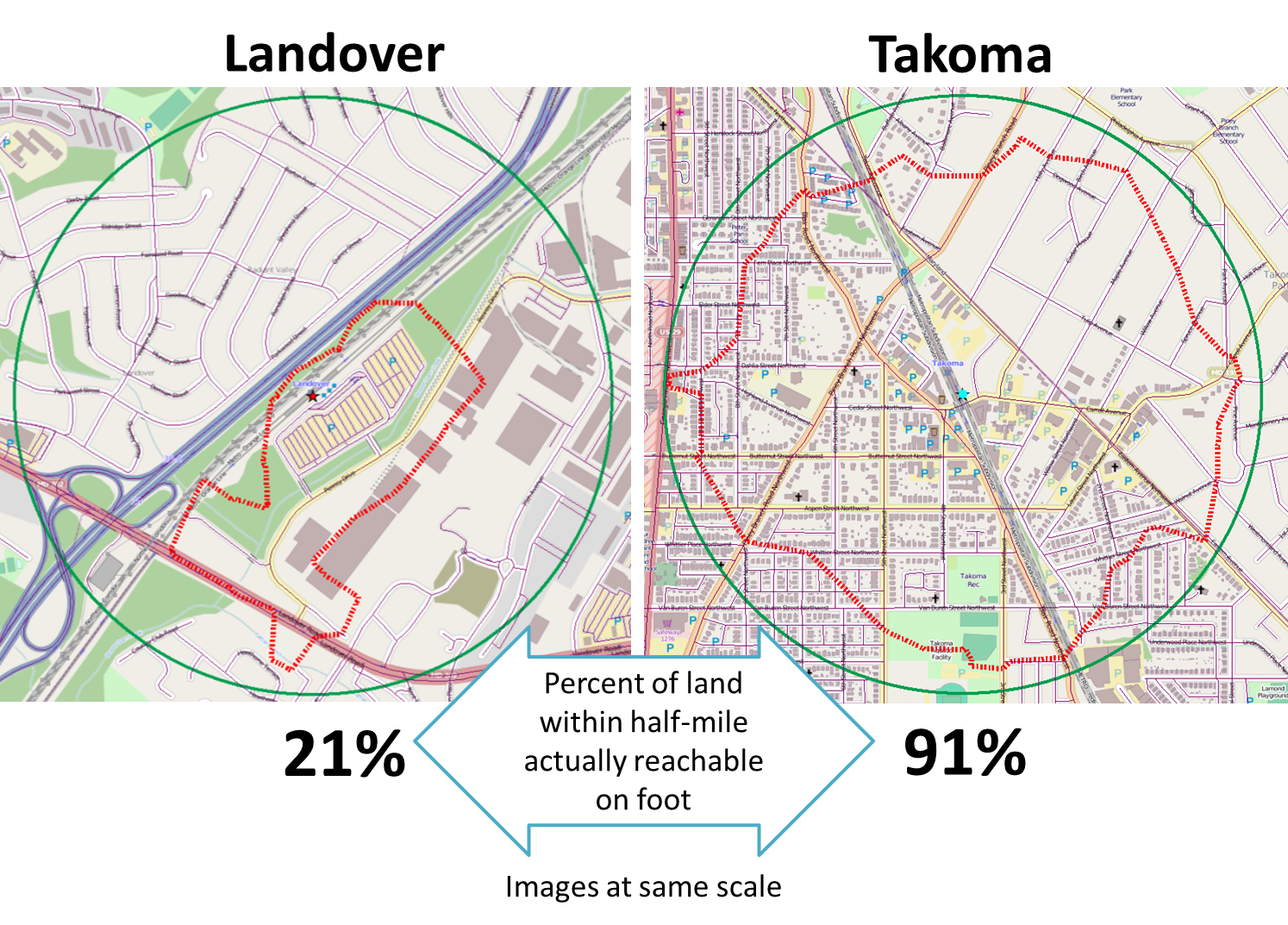
We’ve been focusing a lot on transit walk sheds lately. We’ve shown that the size of a transit walk shed depends heavily on the roadway network and pedestrian infrastructure, and that these sizes vary dramatically by Metrorail station. We’ve also demonstrated that expanding the walkable area can make hundreds of households walkable to transit.
But why do we care so much about walk sheds? Because larger walk sheds mean more households in the walk shed, and that means ridership. For example, we’d be hard pressed to find many households in Landover’s small walk shed, so it’s no surprise that walk ridership at that station is low. On the other hand, thousands of households are within a reasonable walk to Takoma’s larger walk shed, and walk ridership there is much higher.
In other words, the more people can walk to transit, the more people do walk to transit – and data across Metrorail stations prove it:
Correlation between Households in the half-mile walk shed, and AM Peak ridership, by WMATA Metrorail station entrance
More households in the walkable area around a Metrorail station means higher ridership.
The chart above shows that the number of households in a Metrorail station entrance’s walk shed is highly correlated with AM Peak walk ridership at that station.  In fact, the number of households walkable to a Metrorail station alone explains nearly 70% of the variation in walk ridership across Metrorail stations.
Click here to read the rest of this post.

The results and certainly the conclusions are similar to a short, more technical paper we wrote for the Reston Task Force and posted on this blog in 2011 entitled, "The Residential vs. Employment Balance in TOD Areas: Optimizing for Reduced Congestion and Environmental Damage."  The two key graphics in that report show that residents of a Metro station area "walk shed" ("the half-mile circle") are much more likely to use Metro than people who work in that station area.  They also show the converse:  That people who work in a station area are much more prone to drive to that station area at any given distance from the station than are the people who live there.


Our report was based on a 2005 WMATA survey of Metrorail ridership.  Since we are unaware of any more recent such surveys, we suspect the PlanItMetro article is a more fine-grained analysis of the same report.  The results in both these reports is consistent with a significant body of research on the topic:  Residents of a transit station area are much more likely to use transit than workers in the station area. 

Nonetheless, the point received absolutely not attention by the developer-driven task force, which was intent on allowing massive office space development and little residential development, especially within the critical first 1/4 mile of the Metro station.  This was especially true in the Town Center area.  Even advocates for Metrorail on the task force, including its DCRA President chairman, did not grasp--or chose to ignore--the importance of nearby residential development to Metrorail ridership.  The same was true to an even much greater extent in the Tysons Task Force. 

In the end, the County planning staff modestly muted the jobs-to-residential ratio and density (total square footage of allowable developed space) in the final plan subsequently approved by the County Board in the face of traffic analyses that showed even more massive gridlock than we can expect under the approved plan.  The final density, most notably in Reston Town Center, is less than proposed by the task force's Town Center Sub-committee, dominated by Boston Properties and its allies, and a better balance, that is, more residential, than the sub-committee proposed.  Still, the County's analysis of the approved development plan shows that, when the planned development is completed, Restonians can expect five-minute or more traffic delays at each intersection along the key through streets (Reston Parkway, Wiehle) in the station area during peak traffic periods--even if all the planned street infrastructure is in place!

And none of this considers the much reduced--and declining--office space per worker now seen in office property leasing.  Recent trends reported here several times in letters to Board Chairman Sharon Bulova (see here, here, here, and here) show that the office space per worker is being cut by half at least for a variety of reasons, meaning we can anticipate at least twice as many workers in the allowed plan office space than the plan envisions--and about twice as much traffic as has been assessed.

All of this belies the stated goal of Reston Master Plan re-make to take advantage of the arrival of Metrorail since little the task force did actually took advantage of the transit opportunities the arrival of Metrorail presents.  Rather it was about increasing developer and landowner profit opportunities and especially the County's real estate property tax base.  Unfortunately, the turn in the economy and the reduction of federal spending has shown all the growth assumptions prepared by developer-funded GMU's Center for Regional Analysis, including the developer controlled "2030 Group" lobbying entity,  to be grotesquely optimistic.  With little prospect that government spending will suddenly return to pre-recession levels over the next decade or so, the ill-considered tax revenue goals of the County and the grand lease increases envisioned by the developer community appear unlikely to unfold. 

Nonetheless, the now irrevocable legal commitment to office-focused development in the station area means that, whatever happens, there will be fewer riders taking Metrorail than could have been under a more balanced plan focusing on greater residential development in Reston and Tysons station areas.