
This is a re-post from RestonNow, January 11, 2016.
The newly re-elected County Board of Supervisors is at it
again: They are proposing a
“Priority 1” zoning ordinance amendment (ZOA) that would allow development
density in a number of areas in the County to increase to a floor-area-ratio (FAR)
of 5.0 plus a 0.5 bonus density for meeting key County priorities. The ZOA includes all of Reston’s Metro
station areas (TSAs) and Lake Anne, a Commercial Revitalization Area
(CRA).
In fact, the ZOA proposal covers an entire alphabet soup of about
20 urbanizing and redeveloping “Selective Areas” across the county: TSAs, CRAs, CRDs, CBCs, PDCs, and PRMs. Together, the County calls all these
“Selective Areas” and the ZOA makes no distinction among them. That’s a potential half billion gross square
feet (GSF) of new development and redevelopment added to the County’s current roughly
one billion GSF of total existing development of all kinds. And the “Selective Areas” cover only about
five percent of the county’s total 400 square mile area. If you are interested to learn about this
proposed ZOA, there are opportunities for you to hear more and provide your comments
as early as this Wednesday, January 13th.
Here is the key language in the draft ZOA calling for FAR
5.0:
Amend Sect. 6-208, Bulk
Regulations, by revising Par. 3 and adding a new Par. 4 to read as follows:
3.
Maximum floor area ratio: 2.5. However, the
Board may approve an increase up to 5.0 (emphasis added) only when, in the
discretion of the Board, the proposed development is implementing the site
specific density/intensity and other recommendations in the adopted
comprehensive plan for developments located in a Commercial Revitalization
District, Community Business Center, Commercial Revitalization Area and/or
Transit Station Area. (Advertised range
for maximum FAR is 2.5 to 5.5 for areas within the Selective Areas)
While the draft language proposes to limit such approved density
to the limits “in the adopted comprehensive plan,” experience has shown that
this kind of seeming constraint has frequently been ignored in specific
applications, for example, through such seemingly routine legal maneuvers as a
“density swaps.” The Comprehensive Plan—a
legislated guide to development, not a legal constraint—is routinely ignored
when it comes to fulfilling its own quality of life standards. In short, this ZOA opens the door for very high-density
development that substantially exceeds the major increases that the Board has
already approved in the County’s Comprehensive Plan for these “Selective Areas,”
including Reston.
So what does FAR 5.0 look like? To start with, no existing buildings or areas
with that density exist in the County, although some such buildings will soon
be coming to Tysons. The most densely
planned structure in Reston now is the Akridge office building, the 23-story
office building approved at a FAR of 4.06 to replace the current Town Center
Office Building, including five levels of parking and first-floor retail (see
photo).
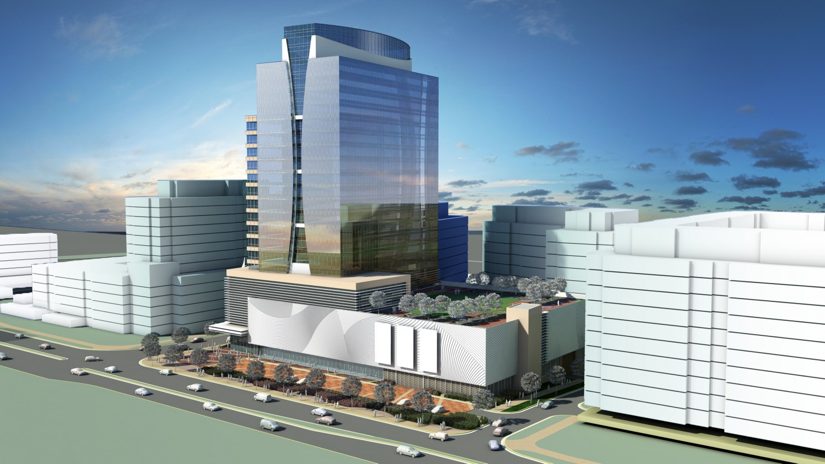 |
| Rendering of approved Akridge office building at FAR 4.06 |
Also, Boston Properties has developed a conceptual plan for its
property near the north side of the Reston Town Center station (see photo). The plan calls for a FAR 4 density, probably
with a FAR 0.5 bonus density, when it is built.
The entire area in that image is also planned for FAR 4 development
under the Reston Master Plan precisely because it is located so close to the
Metro station.
 |
| Boston Properties concept for development near the RTC Metro station. |
The most densely developed TSA in Virginia is the core area
around the Rosslyn Metro station.
Overall, that core station area has a density of FAR 3.6 (see
photo). Its two tallest buildings, twin
390’ 31-story structures—one office, one residential—directly above the
station, are FAR 10.
 |
| The Rosslyn Metro station core area is the densest station area in Virginia. |
The County argues that this ZOA is necessary as an
implementation tool to make allowable the development that has been included in
recent area Comprehensive Plan changes, such as the Reston Master Plan. In fact, no areas outside Tysons have any
plan proposing developing buildings or areas to FAR 5.0, and Tysons has the
necessary zoning authority to do so. In
fact, the background section of the ZOA proposal acknowledges this:
“Staff’s
recommendation for 5.0 FAR is specifically based on the increased intensity
levels that have been adopted for certain geographic areas within the Selective
Areas. Staff also believes the 5.0
maximum FAR recommendation will accommodate the current development intensity scenarios
envisioned by existing comprehensive plan recommendations, but will also accommodate
any future comprehensive plan changes that would specify up to a 5.0 FAR for a specific
geographic area. For example, certain
areas of the Reston TSAs are currently planned for up to 3.5 FAR (note: Wiehle
station area), allowing up to 4.5 FAR (note: Reston Town Center station) if
certain features are included with the application. At this time, there is no zoning district
available to achieve a 4.5 FAR (outside of the Tysons PTC District.)”
So the County proposal is explicitly trying to address a
problem that doesn’t exist and almost certainly won’t for at least a decade or
more even under the most enthusiastic of County growth scenarios. Right now, office vacancies are running above
17% and the housing market has been stagnant for at least two years with a
small average price decrease in the last year, according to the Economic
Development Authority and the County’s
Economic Indicators.
Nonetheless, the foreseeable consequences of FAR 5.0
development are huge, and many consequences are not foreseeable so far in the
future.
Certainly one of the most obvious impacts of increased
density would be greater traffic congestion.
In the case of Reston’s planning task force, the County’s
transportation staff examined the traffic impact using a forecast generated
by MWCOG (Round 8.0), the regional inter-governmental planning group. It
foresees Reston Town Center densities of FAR 3.0-4.0 north of the Dulles Toll
Road (DTR) and FAR 1.5-3.0 south of the DTR in 2030. Nowhere does that forecast suggest that FAR
5.0 densities would be approached in Reston.
The study showed that half of the 16 intersections along the DTR
crossings in Reston would have a failing Level of Service (LOS) grades of “F,”
including four of the six along Reston Parkway, in the evening peak rush period
(see graphic).
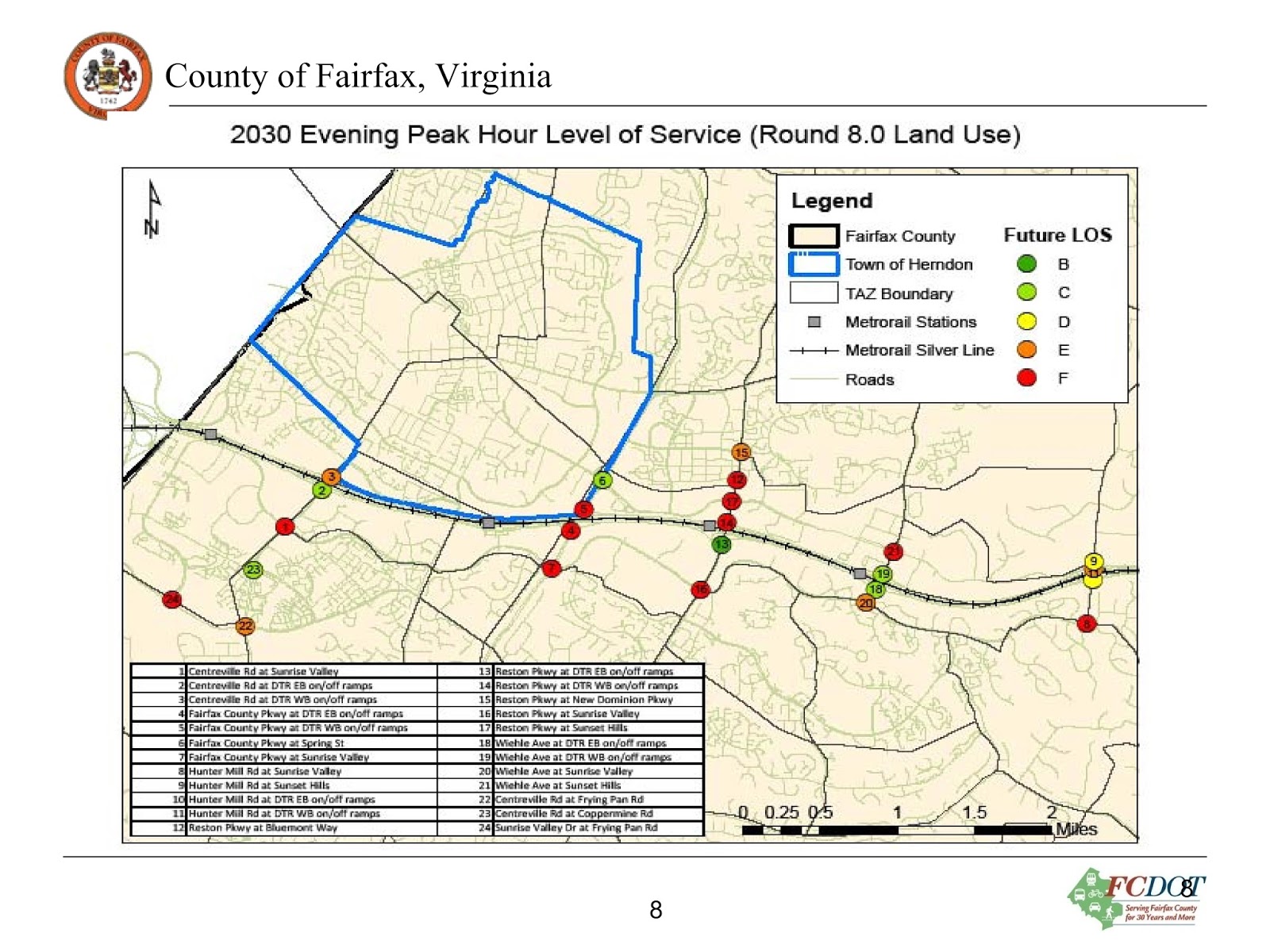
An “F” grade means the intersection is “Oversaturated;
Vehicles wait through multiple signal cycles.”
More concretely, it means at least an 80-second delay at each
intersection, and, in the case of Reston intersections crossing the DTR, waits
of 3-4 minutes at multiple intersections on the same street. While not an expert on how traffic increases
with density increases, it’s reasonable to expect that such delays would easily
double if a FAR 5.0 were allowed in Reston Town Center—with similar
consequences in the other “Selective Areas.”
Meeting current County standards for schools and parks would
also be virtually impossible with a FAR 5.0 in Reston’s 2-1/2 TSAs (half of
Herndon-Monroe TSA being in Herndon) with the County’s coffers as empty as they
are expected to be. To meet that
development level, Fairfax County Public Schools would have to build 3-5
elementary schools, one intermediate school, and a high school—presumably some
of which would be located in the TSAs—to serve the expected 25,000-39,000
students (part of the 59,000-93,000 residents in these FAR 5.0 TSAs). The County Park Authority would also have to
provide 100-150 acres of parks and dozens of athletics fields to meet the needs
of the residents and workers in these areas to meet park goals in the Comprehensive Plan (see
Appendices 2 & 3).
The Park Authority has abandoned any pretense of meeting the
Comprehensive Plan’s Urban Park Framework park acreage goals or the Park Facility
Service Level Standards for Reston’s TSAs even in the current Reston Master Plan. And the single new elementary school proposed
in the current Reston plan is proposed to be located less than ¼ mile from an
existing one (Dogwood) south of the DTR and more than a mile from where it will
be needed north of the Wiehle Metro station.
In short, experience shows the ZOA would create more quality
of life of problems across the County than the County could or would
address. So why should Reston residents
expect the Board of Supervisors would try to meet its own legislated community
service standards for Reston or any other “Selective Area” under a zoning
ordinance offering developers the opportunity for an even more profitable
density of FAR 5.0 and the County greater potential property tax revenues? The record so far has been one of consistent
County failure to meet its quality of life standards for our communities in
redevelopment, including Reston.
That said, Restonians and other County residents will have a
chance to listen to more about this proposed ZOA as well as ask questions at
two meetings within the next two weeks.
The first meeting
is sponsored by the Fairfax County Federation of Citizens Associations
(FCFCA). It is holding a workshop on Wednesday, January 13, 2016, at
7:30PM to 9:30PM at the Providence Community Center, 3001 Vaden Drive,
Fairfax, VA 22031. After an opening
introduction providing context to the proposal, a panel of citizens will
discuss the impact on their communities followed by an open forum in which
people may ask questions, offer suggestions, etc.
The second meeting is
the official Fairfax County “public input” session at 7:30PM, Wednesday,
January 20, 2016. The meeting will
be held at the Board Auditorium in the Fairfax County Government Center at
12000 Government Center Parkway, Fairfax, Virginia. This is not a public hearing. It is an informal input session.
I strongly recommend that you attend one or both of these
meetings to learn more about this important planning and development issue.

