Reston Spring

Reston Spring
Reston Spring
Showing posts with label Placemaking. Show all posts

Friday, February 8, 2013

What does it really mean to make a "place"?

In his post, Opportunity is Local (Or: You Can’t Buy a New Economy), on the Project for Public Spaces website, Brendan Crain puts a new twist on what placemaking is all about.  In his view, the essence of placemaking is about the people, not the place.  He begins:
“At the heart of my argument,” writes Jim Russell in his response to last Wednesday’s blog post, “is the fact that [Placemaking] initiatives are intrinsically place-centric. Instead of place-centrism, I’m looking at talent migration through a lens of people-centrism…I’m convinced that placemaking is useful, but not for talent attraction/retention. People move for purposes of personal economic development.” . . .
A key difference in definitions here is that what some would call ‘place’, I (and others) would call branding. There’s an oceans-wide gap between those two things. . . 
The essence of his argument:
To really grow an economy, opportunity has to be developed organically within each community, and that requires that people dig in and improve their neighborhoods, together, for the sake of doing so–not convincing Google to open a new office down the road. . .
Decades ago we, as a society, detached people from place. We decided that places should be shaped based on theories and ideas, rather than the needs of people who already lived, worked, and played there. The development of people and places is the same process. If we keep trying to separate the two, our cities will remain divided.
 Click on the post title above to read this thoughtful article.  
 

Friday, January 25, 2013

10 Principles for Liveable High Density Cities: Lessons from Singapore, Urban Land Institute, January 24, 2013

This article, a summary of the Urban Land Institute (ULI) study, sounds like it was taken from Reston's Vision and Planning Principles--or even Bob Simon's original vision for our community. 

10 Principles for Liveable High Density Cities: Lessons from Singapore draws upon Singapore’s successful urbanization experience – despite its population density, the city-state has consistently ranked favorably in various surveys measuring the liveability and sustainability of cities around the globe.
The ten principles in the publication were developed during two workshops hosted in 2012 by the CLC (Singapore's Centre for Liveable Cities) and ULI Asia Pacific, bringing together 62 thought leaders, experts and practitioners from different disciplines related to urban planning and development. Discussions at the first workshop centred around the four case study districts in Singapore that both organizations consider to be both densely populated and highly liveable: the mixed-use downtown district of Marina Bay; the commercial corridor of Orchard Road, and two new public housing developments in Toa Payoh and Tampines. The ideas and principles so generated were further developed, corroborated, and condensed into ten principles. . .
  • Plan for long-term growth and renewal –A highly dense city usually does not have much choice but to make efficient use of every square inch of its scarce land. Yet city planners need to do this in a way that does not make the city feel cramped and unliveable. A combination of long-term planning, responsive land policies, development control and good design has enabled Singapore to have dense developments that do not feel overly crowded, and, in fact, are both functional and aesthetically pleasing.
  • Embrace diversity, foster inclusiveness – There is a need to ensure that diversity is not divisive, particularly in densely populated cities where people live in close proximity to one another. Density and diversity work in Singapore because there has always been a concurrent focus on creating a sense of inclusiveness through encouraging greater interaction.
  • Draw nature closer to people – Blending nature into the city helps soften the hard edges of a highly built up cityscape and provides the city dwellers pockets of respite from the bustle of urban life. By adopting a strategy of pervasive greenery and by transforming its parks and water bodies into lifestyle spaces for community activities, Singapore integrated nature with its dense developments. Nearly half of Singapore is now under green cover, which is not only aesthetically pleasing, but also improves the air quality and mitigates heat from the tropical sun.
  • Develop affordable, mixed-use neighbourhoods – The ease of living in a compact neighbourhood that is relatively self-contained can add to the pleasure of city living. With density, it becomes more cost effective to provide common amenities. Neighbourhoods in Singapore’s new towns have a mix of public and private developments which are served with a full range of facilities that are easy to access and generally affordable.
  • Make public spaces work harder – Often, parcels of land that adjoin or surround the city’s infrastructure are dormant, empty spaces. Singapore has sought to maximize the potential of these spaces by unlocking them for commercial and leisure activities, The idea is to make all space, including infrastructural spaces, serve multiple uses and users.
  • Prioritise green transport and building options – An overall reduction in energy consumption and dependence adds to city sustainability. Singapore has adopted a resource-conscious growth strategy that relies on planning, design and the use of low-energy environmental systems for its buildings. It has also developed an efficient public transport system and well-connected walkways to give city dwellers transport alternatives to driving.
  • Relieve density with variety and add green boundaries – A high-density city need not be all about closely packed high-rise buildings. Singapore intersperses high-rise with low-rise buildings, creating a skyline with more character and reducing the sense of being in a crowded space.
  • Activate spaces for greater safety – Having a sense of safety and security is an important quality-of-life factor. As Singapore became denser, designs of high-rise public housing estates were modified to improve the “visual access” to spaces so the community can collectively be the “eyes on the street,” helping to keep neighbourhoods safe.
  • Promote innovative and non-conventional solutions – As a city gets more populated and built up, it starts facing constraints on land and resources, and has to often look at non-traditional solutions to get around the challenges. To ensure sufficient water, Singapore developed reclaimed water under the brand name NEWater-to drinking and industrial standards.
  • Forge “3P” (people, public, private) partnerships – With land parcels in close proximity to one another, the effects of development in one area are likely to be felt quickly and acutely in neighbouring sites. The city government and all stakeholders need to work together to ensure they are not taking actions that would reduce the quality of life for others. URA launched the Singapore River ONE partnership to get the various stakeholders to feel a stronger ownership of Singapore River so that social and economic activity in the precinct would be developed in a coordinated and sustainable manner.
From my own experience in Singapore, one of the most densely populated place on the planet, I can say that it is a beautiful tropical city-state with especially attractive parks and open spaces that utilizes transportation demand management (TDM) methods to the extreme, e.g.--only specially licensed vehicles in the core business district.  From the foreword of the report:
Indeed Singapore’s former Prime Minister Mr Lee Kuan Yew observed
in an interview with the Centre for Liveable Cities that a good city is one
that is clean, creates a sense of safety and space, provides mobility and
connectivity, and above all, “a sense of equity, that everybody owns a part
of the city.”
 Worthy goals for Reston's new urbanizing core.

Saturday, January 19, 2013

Eleven Principles to Turn Public Spaces into Civic Places, Project for Public Spaces

Several key principles are essential to creating any successful public space. These principles begin with numerous underlying ideas, the first of which is that the community is the expert — the most knowledgeable and best resource for the professionals that are responsible for designing or managing the space. The second is that when one creates a “place,” the entire project needs to be viewed differently. Partnerships are the third basic tenet because anyone who manages a space knows that it cannot be done alone. Finally, when embarking on a process for creating a successful space, one must accept that there always will be people who will say that it can’t be done — yet one can learn to work around the obstacles.
Other remaining principles include techniques for planning and outreach, translating ideas into action and implementation. All 11 principles are illustrated below with recommended steps to ensure that the goals are reached, as well as case studies from GSA projects.

Underlying Ideas:

Planning And Outreach Techniques:

Translating Ideas into Action:

Implementation:

Click on each topic for a discussion of the principle, including case studies. 


Monday, December 10, 2012

What Makes a Great Public Destination? Is it Possible to Build One Where You Live? The Project for Public Places, November 11, 2012

In a recent blog post, entrepreneur-turned-VC Mark Suster wrote about the necessary ingredients for a city trying o develop a successful start-up community. His advice seemed applicable to any community that’s trying to create a strong local sense of place, so we’ve retrofitted his recommendations to speak broadly to people who are working to transform their public spaces into magnetic destinations that are reflective of the diverse communities that surround them.
 Here is the list of the requirements discussed in this article from Suster's post:
  • A Strong Pool of Zealous Nuts
  • Place Capital
  • Killer Events
  • Access to Great Advocates
  • Motivated Champions
  • Local Press/Websites/Organizational Tools 
  • Alumni Outreach
  • Wins 
  • Recycled Place Capital/Repeat Placemakers  
  • Flagship Public Spaces 
Click here for the full article and its description of these requirements. 

Monday, December 3, 2012

10 Techniques for Making Cities More Walkable, The Atlantic Cities, December 3, 2012


Kaid Benfield,  director of the Sustainable Communities and Smart Growth program at the Natural Resources Defense Council, co-founder of the LEED for Neighborhood Development rating system, and co-founder of Smart Growth America, summarizes the ten ways we can make cities more walkable as detailed in a new book, The Walkable City, by Jeff Speck.

The money quote from the book:
The conventional wisdom used to be that creating a strong economy came first, and that increased population and a higher quality of life would follow. The converse now seems more likely:  creating a higher quality of life is the first step to attracting new residents and jobs.

Here's his list of the key techniques for improving quality of life:
  1.  Put cars in their place.
  2.  Mix the uses.
  3.  Get the parking right.
  4.  Let transit work. 
  5.  Protect the pedestrian.
  6.  Welcome bikes.
  7.  Shape the spaces.
  8.  Plant trees.
  9.  Make friendly and unique [building] faces.
  10.  Pick your winners.
For his discussion of these features, read the entire article here.  

Friday, November 30, 2012

What Makes a Successful Place? Project for Public Spaces

Great public spaces are where celebrations are held, social and economic exchanges take place, friends run into each other, and cultures mix. They are the “front porches” of our public institutions – libraries, field houses, neighborhood schools – where we interact with each other and government. When the spaces work well, they serve as a stage for our public lives.
What makes some places succeed while others fail?
In evaluating thousands of public spaces around the world, PPS has found that successful ones have four key qualities: they are accessible; people are engaged in activities there; the space is comfortable and has a good image; and finally, it is a sociable place: one where people meet each other and take people when they come to visit. PPS developed The Place Diagram as a tool to help people in judging any place, good or bad:


The article goes on to explain what these concepts mean and how they apply in building public spaces in a placemaking manner.  It includes a number of questions that help evaluate how a place measures up.

Wednesday, October 31, 2012

What Draws Creative People? Quality of Place, Richard Florida, UrbanLand, October 11, 2012

Patty Nicoson, Chairman of the Reston Task Force, shared this article with members of the task force.  It provides a tilt on the "quality of life" concept called "quality of place."  From this person's perspective, quality of place is a prerequisite for quality of life.

Here are some excerpts:
Why do people—especially talented Creative Class people, who have lots of choices—opt to locate in certain places? What draws them to some places and not to others? Economists and social scientists have paid a great deal of attention to the location decisions of companies, but they have virtually ignored how people, especially creative people, make the same choices. . .
Place itself, I began to realize, was the key factor. So much so, that I coined a term—quality of place—to sum it up. I use the term in contrast with the more traditional concept of quality of life to cover the unique set of characteristics that define a place and make it attractive. Over time, my colleagues and I have come to refer to these characteristics as Territorial Assets, the fourth T of economic development after Technology, Talent, and Tolerance (what I have elsewhere called the 3Ts of Economic Growth).
Generally, one can think of quality of place as cutting across three key dimensions:
  • What’s there: the combination of the built environment and the natural environment; a stimulating, appealing setting for the pursuit of creative lives.
  • Who’s there: diverse people of all ethnicities, nationalities, religions, and sexual orientations, interacting and providing clear cues that this is a community where anyone can fit in and make a life.
  • What’s going on: the vibrancy of the street life, café culture, arts, and music; the visible presence of people engaging in outdoor activities—altogether a lot of active, exciting, creative goings-ons. . . .
Click here for the rest of this interesting article.  

Thursday, March 29, 2012

Eleven Principles for Creating Great Community Places, Project for Public Spaces

Effective public spaces are extremely difficult to accomplish, because their complexity is rarely understood. As William (Holly) Whyte said, “It’s hard to design a space that will not attract people. What is remarkable is how often this has been accomplished.”
PPS (The Project for Public Spaces) has identified 11 key elements in transforming public spaces into vibrant community places, whether they’re parks, plazas, public squares, streets, sidewalks or the myriad other outdoor and indoor spaces that have public uses in common. These elements are:
1.  The Community Is The Expert
. . .  Tapping this (community) information at the beginning of the process will help to create a sense of community ownership in the project that can be of great benefit to both the project sponsor and the community.
2.  Create a Place, Not a Design
 . . . To make an under-performing space into a vital “place,” physical elements must be introduced that would make people welcome and comfortable, such as seating and new landscaping, and also through “management” changes in the pedestrian circulation pattern and by developing more effective relationships between the surrounding retail and the activities going on in the public spaces. . . .
3.  Look for Partners
. . .  they are invaluable in providing support and getting a project off the ground. . . .
4.  You Can See a Lot Just By Observing
. . .  By looking at how people are using (or not using) public spaces and finding out what they like and don’t like about them, it is possible to assess what makes them work or not work. . . .
5.  Have a Vision
. . .  essential to a vision for any public space is an idea of what kinds of activities might be happening in the space, a view that the space should be comfortable and have a good image, and that it should be an important place where people want to be. . . .
6.  Start with the Petunias: Lighter, Quicker, Cheaper
. . .  The best spaces experiment with short term improvements that can be tested and refined over many years! . . .
7.  Triangulate
. . .  In a public space, the choice and arrangement of different elements in relation to each other can put the triangulation process in motion (or not). . . .
8.  They Always Say “It Can’t Be Done”
. . . Creating good public spaces is inevitably about encountering obstacles, because no one in either the public or private sectors has the job or responsibility to “create places.” . . .
9.  Form Supports Function
The input from the community and potential partners, the understanding of how other spaces function, the experimentation, and overcoming the obstacles and naysayers provides the concept for the space. . . .
10.  Money Is Not the Issue
. . . (Once the infrastructure is in place and the community and partners are involved), people will have so much enthusiasm for the project that the cost is viewed much more broadly and consequently as not significant when compared with the benefits.
11.  You Are Never Finished
. . .  Being open to the need for change and having the management flexibility to enact that change is what builds great public spaces and great cities and towns.
Most of these principles make tremendous sense for the future development of Reston in either the TOD areas or beyond.  Some, such as "money is not the issue," are not quite on track.  Just ask the Tysons planning committee whether money is an issue, for example.

For the rest of this article, click here.

Tuesday, October 25, 2011

What works in cities: Why placemaking requires passion even more than big budgets, YongeStreet

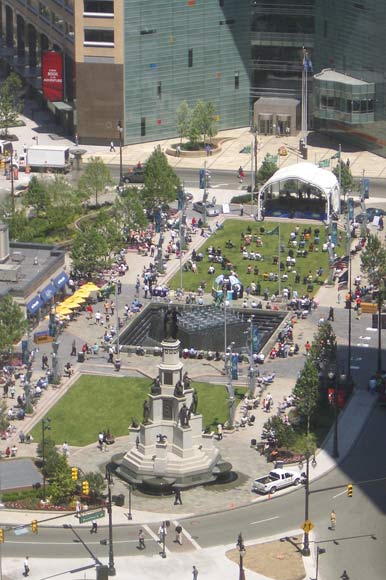
An article by Michele Bruche in YongeStreet--a Toronto online magazine on "all the things that create incredible demand for this place and keep it growing"--highlights the importance of public spaces and the community's role in their creation.  In this case, the place is Campus Martius Park in a renewing Detroit.  The article begins:
Before Detroit's Campus Martius Park opened in 2004, many of the historic buildings around it had emptied. Major department stores were vacant or torn down.

"Nothing was there," says Bob Gregory, president of Campus Martius Park. "It was not a very pleasant place to be."

To turn it around, the mayor's office established a task force that studied the best public spaces in the world and quizzed the locals on how they would use a new park. After a $20-million investment, the park started buzzing year-round with music, a bistro, and ice skating under colourful lights and a giant Christmas tree. The park has since attracted several new corporate headquarters, new condos and a whopping one million park visitors each year.

The strategy that built Campus Martius is called "placemaking," and it's a development approach gaining momentum across the continent. The strategy gives local residents and stakeholders a major voice in shaping new development. . . .
Campus Martius Park, Detroit, MI
. . . The state of Michigan, for example, is focusing on placemaking initiatives as part of its economic development strategy. "Economic development and community development are two sides of the same coin," Gov. Rick Snyder told the Michigan Legislature last winter. "A community without place amenities will have a difficult time attracting and retaining talented workers and entrepreneurs, or being attractive to business." (emphasis added)

Kent's son, PPS vice president Ethan Kent, says placemaking is striking a chord in the current economy because it's resourceful and builds on a city's existing assets. And the placemaking philosophy requires extensive public buy-in upfront, so officials can stand on safer ground politically. "Building convention centers and using tax incentives to attract big corporations or new business isn't working," Ethan says.  (emphasis added)
Click here for details on this placemaking effort and the role of Fred Kent in pursuing placemaking initiatives.