Reston Spring

Reston Spring
Reston Spring
Showing posts with label Reston PRC. Show all posts

Monday, May 27, 2019

CPR sends important issue questionnaire to all Hunter Mill District supervisor candidates.


Coalition for a Planned Reston Candidate Questionnaire

Please answer each question and, if desired, provide explanations in a brief statement following all of the questions and answers.

1.  The Fairfax County Planning Commission voted unanimously to reject a proposal to increase the population cap in Reston's Planned Residential Community (PRC) areas to a number greater than 13 persons per acre.  The Board of Supervisors then voted unanimously to "indefinitely defer" action on this proposal.  

            Do you agree with the Planning Commission that there should be no increase in the overall density of the PRC?    YES___    NO____

2.  The Reston Master Plan specifically supports there being two full sized (18 hole) golf courses in Reston.  Fairfax County guidelines also call for at least two golf courses in Reston.  

            Do you support maintaining a firm and unwavering line on maintaining existing zoning laws that will ensure Reston has adequate open space, specifically to include two 18-hole golf courses?    YES___    NO___

3.  The Fairfax County Master Plan specifically emphasizes the vital need for citizen input on land use issues.  

            Do you support having a balanced composition (local private citizens and local business persons) to any task force, working group or similar committee dealing with land use and development matters?   YES___ NO___

4.  In recent years a number of development applications have requested and been granted waivers to zoning and other regulations and guidelines meant to promote safety, accessibility, and the quality of life and esthetics of Reston. This has resulted in the loss of open space, crowded roadways, noise and light pollution and unaesthetic buildings.  

            Do you support the elimination of granting such waivers as a matter of common practice and requiring strict compliance with building and zoning ordinances to preserve the essential nature of Reston and the remainder of Fairfax County?     YES___   NO___

5. A position on the Fairfax County Board of Supervisors is a demanding and time -consuming undertaking.

If you are elected to the Fairfax County Board of Supervisors will you resign from all other jobs and make the County Supervisor position your exclusive and full-time job?   YES___   NO___

6. One of the key concerns for residents of Reston and the Hunter Mill District more generally is the delay between the approval of developments and the availability of funding and implementation of planned infrastructure and schools to support the increased number of residents associated with the approved developments.

If you are elected to the Fairfax County Board of Supervisors will you support legislation by the Virginia General Assembly to authorize Fairfax County to more effectively maintain infrastructure in phase with development?   YES___   NO___


Candidate’s Statement (optional):


Monday, March 11, 2019

Thank you, Reston!

To all the wonderful Restonians and other neighbors in our broader Fairfax community, we want to extend our deepest appreciation for your support over the past two years against the proposed zoning amendment that would have increased the density cap in our Planned Residential Community (PRC) area.  Your many letters and phone calls to members of the Fairfax County Board of Supervisors and Planning Commission, your participation in the community meetings held in Reston, including the pivotal October 2017 public meeting at South Lakes High School, and your attendance at the February meeting of the Fairfax County Planning Commission were absolutely critical in demonstrating to our elected officials the community’s resolve in opposing the density increase.

We also applaud the unfailing support of our partners in this fight, Reston Association and the RA Board, which have been unanimous in their support. RA staffers put in days of work to research the details of proposals and zoning regulations and to speak at public hearings in defense of our planned community.

Other key partners include Rescue Reston and its North Course Committee, established to protect Reston’s two 18-hole golf courses. Their vigilance and experience were invaluable in broadening community awareness and monitoring the ongoing effort to redevelop the Hidden Creek Golf Course. And Rescue Reston has worked diligently to protect both golf courses as an ecological, zero-density counter-balance to increased development, particularly in terms of preserving our all-important tree canopy, wildlife habitats, and flood plains—protection validated by Supervisor Hudgins in her statement withdrawing the zoning amendment.

The proposed zoning amendment was indefinitely deferred at Tuesday’s Board of Supervisors meeting, a positive outcome that would never have happened without the extensive involvement of everyone. However, the battle is far from over. The Planning Commission has recommended that the Board establish a new task force to review the Reston Master Plan, a task force that would include members of the Reston community as well as local business representatives. We will all need to follow this development carefully and to participate fully in all community meetings convened to review and discuss possible changes.

With your continued support and involvement, together we can help shepherd a good plan for the future of Reston and ensure a healthy and functioning planned community for our children, our grandchildren and our planet.Thank you again!

With gratitude, Coalition for a Planned Reston

(Reston Citizens Association, Reston 20/20, Reclaim Reston)

Tuesday, March 5, 2019

VIDEO: Board of Supervisors discusses, approves motion to defer indefinitely an increase in the Reston PRC zoning ordinance amendment


BREAKING NEWS: Board of Supervisors agrees to defer Reston PRC zoning amendment indefinitely


At 12:02 PM, March 5, 2019, the Fairfax County Board of Supervisors approved unanimously a motion by Supervisor Cathy Hudgins to postpone indefinitely consideration of her proposal to increase the authorized density in Reston’s PRC zoned areas from 13 to 15 people per acre.  

The Board’s vote ends a 22-month saga (starting May 3, 2017) in which the Supervisor Hudgins, county staff, and Reston organizations worked to understand the implications of the proposed amendment for Reston and reasons for its alleged necessity.  Throughout the time frame, it became increasingly obvious that the people of Reston, all directly affected by the proposed amendment, broadly opposed adoption of the zoning amendment.   This opposition peaked at a community meeting arranged by Supervisor Hudgins in October 2017 at South Lakes High School attended by more than 900 Restonians.  More than 100 people stood to comment in opposition to the proposal.

Follow-up small group discussions in 2018 between community representatives and county staff failed to close the gaps in justifying the zoning proposal.   In fact, county staff failed to answer questions laid out by community representatives until a week before Supervisor Hudgins was scheduled to propose the advertisement of the zoning amendment proposal.   The answers were pro forma and failed to add significant information to that which was already known.  Nonetheless, and despite her commitment to the contrary in the absence of substantive responses to the community’s concerns, Supervisor Hudgins moved forward with her proposal to advertise the PRC zoning ordinance amendment proposal—the first legislative step in approving  zoning ordinance amendment—on December 4, 2018.

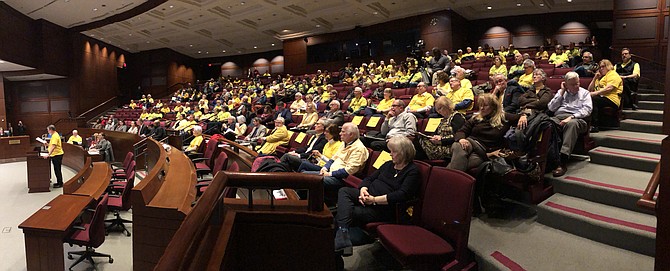
Thereafter, with the widespread participation of Restonians, community representatives from the Coalition for a Planned Reston (CPR) and Reston Association (RA) pressed hard to inform the community, the Planning Commission, and members of the Board of Supervisors of the issues with the proposed zoning amendment.  Hundreds of Restonians wearing yellow shirts showed up at the Planning Commission hearing and more than a dozen testified in opposition to the proposed amendment.  In its decision, the Planning Commission recommended against adoption of the zoning ordinance amendment and called for a revamped Reston Master Plan tied concurrently to a new zoning ordinance approval. 

As a result, Supervisor Hudgins decided to request that the Board of Supervisors defer indefinitely its consideration of the PRC zoning ordinance amendment.   Her motion to do so was passed unanimously by the Board on March 5, 2019.

It is not clear when the county will follow through on the Planning Commission’s recommendations, but it is not likely to occur until next year when a new Board of Supervisors is in place. 

We commend--and thank--all Restonians who participated in any way in stopping this ill-considered zoning amendment.  It was absolutely essential to the preservation of Reston as a planned community.   While we have achieved a major victory in sustaining the vision laid out by Reston’s founder, Robert E. Simon, our reward will be to have to tackle the planning and zoning issue once again after the decade of effort that got us here. We will continue to keep the community advised of the planning and zoning issues in Reston as they arise.

Thursday, February 28, 2019

Board of Supervisors Package for Its Hearing on the Proposed PRC Zoning Ordinance Amendment, March 5, 2019

The package below has been assembled by the County planning staff for the Board of Supervisors as background prior to its hearing on the proposed PRC zoning ordinance amendment that would increase Reston's overall density and, specifically, the density in the Village Centers.  It includes background on the proposal, the Planning Commission's verbatim discussion of the proposal and its recommendations to the Board, the planning staff's original staff report and more.

Thursday, February 14, 2019

CPR Comment on Planning Commission Recommendations to the Board of Supervisors to Reject the Proposed PRC Zoning Amendment and Proposal to Establish a Task Force with Appropriate Reston Resident Participation, February 14, 2019


Coalition for a Planned Reston
A voluntary group of residents from the Reston Citizens Association,
Reclaim Reston, and Reston 20/20


FOR IMMEDIATE RELEASE

February 14, 2019

The Coalition for a Planned Reston (CPR) appreciates the thoroughness and thoughtfulness with which the Fairfax County Planning Commission has dealt with the proposal to raise the population cap of Reston’s Planned Residential Community (PRC.) 

CPR leadership is pleased with the Planning Commission’s determination that several of CPR's core positions are valid and in the best interest of the community. 

Specifically:

  • The Commission voted unanimously to recommend the Board of Supervisors reject the proposed density increase (and keep the cap at 13);
  • The Commission reaffirmed the need to link zoning to the Comprehensive Plan; and 
  • The Commission encouraged the formation of a Task Force to work on these issues with appropriate independent citizen participation.   

All of this has been accomplished by the involvement and action of thousands of Restonians and Reston well-wishers who have written letters, made phone calls, attended meetings, spoken to officials and helped CPR raise awareness in the community.   This was the decisive factor in achieving this result.    

While we are pleased with the Planning Commission's considered decisions, we note that this is not the end of attempts to diminish the uniqueness of Reston.  The matter now goes to the Board of Supervisors who have the final say.  While we believe the Supervisors should accept the Commissioners' recommendations, they have no obligation to do so.  The proposal on the density increase is on the calendar for Supervisors' meeting of March 5th.   We thus will continue to work to inform all the Supervisors about this issue and the destructive impact it would have if passed.   

Further, if the proposal to create a new Task Force is approved, a great deal of work will need to be done to ensure citizens' voices are heard and that the guiding principles of Reston are not pushed aside for short-term, self-interested gain.

CPR wishes to thank everyone who pitched in to preserve a functioning planned Reston. Please stay alert and informed.  Your continued passion is needed.

###
Media Contact: Lynne Mulston, Coalition for a Planned Reston (703-662-1687) 

Thursday, January 31, 2019

"What's the number?" E-mail to Planning Commission and Board of Supervisors by Terry Maynard, January 29, 2019

Dear Commissioners and Supervisors,

In the January 23rd Planning Commission hearing on increasing the density cap in Reston's PRC from 13 to some higher number, Mr. Hart asked the critical question, "What's the number?"  If not 13 people per acre, then what should it be?  From my perspective, the number for the population cap in the Reston PRC is, and should remain indefinitely, 13 persons per acre.  

If the Reston PRC overall P/A number is increased, even a little, it destroys the basis for it being fixed at any level as part of our founder’s vision and a true master plan.  In so doing, it extinguishes the core foundation of Reston as a planned community with a well-considered balance between residents, jobs, open space, and infrastructure.  Instead, the community and the county would just keep chasing the population cap higher or abolish it all together as property owners continue to seek to add density.  It does nothing for jobs, open space, or infrastructure (as many Reston speakers highlighted at the recent hearing).  Planned community destroyed.  

It seems clear to me that Bob Simon fully appreciated that Reston would have mass transit in the Dulles Corridor in addition to the access road and toll road.  With that in mind, a 1990s version of the Reston Master Plan stated that the maximum (not “target”) population of Reston is 130,000 people.   (That map is no longer publicly available.)  This is consistent with the story presented by Mark Looney at the Planning Commission hearing, and just because the result was a simple equation doesn’t mean it was not well considered.  For example, how about E = mc2?  Simple, but with huge implications—and it took years to formulate.     Not surprisingly, with an overall Reston acreage of about 10,000 acres, that 130,000 population cap works out to 13 people per acre. 

His logic, as reported in A Brief History of Reston, Virginia (Gulf Reston, 1970, p. 11) was: "Our present zoning ordinances (which isolated land uses) are largely responsible for the diffusion of our communities into separate, unrelated hunks without focus, identity or community life. They have helped produce chaos on our highways, monotony in our subdivisions, ugliness in our shopping centers. They are to blame for the whole neon-lighted wasteland that exists."  And, yes, neon lights have appeared on Comstock’s new office building at Reston Station.  He was more prescient than could have been imagined.

The Reston Master Plan as approved by the Board of Supervisors in 2014 (Phase 1 TSA revisions) came close to defining that 130,000 limit.
It targeted the development of 28,000 dwelling units (DUs) in the TSAs, about 59,000 people.
The largely suburban PRC areas of Reston would top out at about 82,000 people at 13 p/a less the overlap between the PRC and TSA in Reston Town Center comprising about 11,000 DUs, or about 23,000 people.   (My best estimate of the current RTC PRC population is about 13,000 people in some 6,300 DUs.  This is based on Fairfax County and RA data.)
Netting that all out (59,000 TSA + 59,000 non-TSA) leads to a potential Reston population of 118,000 people in “One Reston,” approaching the cap laid out in the Reston Master Plan some two decades ago.   And it would allow a virtual doubling of Reston’s current population (which the US Census estimates at 60,352 in its 2012-2017 ACS survey) in four decades that it has taken well over five decades to achieve.   Our experience shows that that is certainly enough growth to try to manage in any master plan, zoning ordinance, or supporting budget. 

Some of the further implications of that calculation are: 
We need to “down plan” the target residential potential of the TSAs from 44,000 DUs (2015 plan amendment) to 28,000 DUs (2014 Phase 1 plan approval).  This was the total number of DUs developed by the Phase 1 Reston Master Plan Task Force for Reston’s station areas.
We should not change the number of development categories in the PRC zoning ordinance (low, medium, high) or their values (maximum of 50 DU/A for MF DUs).  As RA has pointed out, only one development application has so far exceeded that density limit.  There should be no more.
Village centers should be re-developed at not more than a moderate density (30 DUA), not the 50 DUA proposed in the current PRC zoning amendment proposal.  In this manner, they would remain "neighborhood serving" as called for in the Reston Master Plan rather than just high-density annexes isolated from the transit station areas.   
It is clear, as members of the Planning Commission have stated, that we need to re-connect the Reston plan with the PRC zoning ordinance before considering changes to the latter.   With the next scheduled Reston plan effort set for 2020, I think the Planning Commission has the time to lay the groundwork for that effort before moving forward on this zoning amendment.  My only “ask” is that the new effort must include a strong community voice—people representing Reston residents’ interests—in the re-shaping of our community plan and zoning.

In the meantime, I think the Hippocratic Oath applies to the Reston body politic as much as it applies to the body human:  “First, do no harm.”

Thank you for your consideration—and your patience,


Terry Maynard

Photo: Yellow-shirt Restonians flood the Planning Commission hearing on the proposed PRC zoning amendment, January 23, 2019

Photo by Mercia Hobson, Reston Connection, January 30, 2019
Click here to read Mercia Hobson's article on the Planning Commission hearing. 

Wednesday, January 23, 2019

Letter: Commercial and County Interests Push Super-Density in Reston despite Community Calls for Balanced Growth--Extended Version

This is an extended version of a letter by Terry Maynard published in RestonNow.  It includes more details and graphics.


As a Restonian who has worked hard on Reston planning and zoning for more than a decade, I was stunned by the letter, linked to in this RestonNow article, signed by 17 people, many of whom are associated with the Greater Reston Chamber of Commerce (GRCOC), to Supervisor Hudgins.  The letter, signed by GRCOC Board Chairman Charlene Wheeless (Bechtel), GRCOC President and CEO Mark Ingrao, GRCOC Executive Committee Member Mike Jennings, and Mark Looney (GRCOC representative to the Reston Master Plan Task Force—RTF—and land use attorney), was so full of inaccuracies and untruths it could readily be labelled “fake news.”  

One of the most stunning claims in the letter was that “Reston’s Comprehensive Plan was the product of a five-year planning process involving the full community.”  The fact of the matter is that the Reston community was marginalized throughout this timeframe and its contributions opposed by developers and ignored by the county. 

Let’s take a look at what REALLY has happened in this near-decade effort to re-plan and re-zone Reston.   

Only six of the two dozen primary members of the RTF studying Phase 1 (the transit station areas) were Reston residents who represented the interests of Reston residents.  They included representatives from three community organizations—Reston Association (RA), Reston Citizens Association (RCA), and Alliance of Reston Clusters and Homeowners (ARCH)—and three independent “at large” residents.  Another “at large” member from Herndon held views aligned with Reston’s community representatives.  Three of RTF’s members, including the chair of the task force, represented organizations promoting the extension of the Silver Line.  The rest, including the Reston Community Center, represented private and government development interests in Reston—more profits, more taxes.

No community representative, then or now, has opposed reasonable residential and commercial development in the transit station areas.  They have objected and continue to object to the excessive development proposed by private and county land use interests.

The Task Force recommended 27,932 dwelling units (homes for about 59,000 people) in the station areas based on study of multiple density and mix scenarios, a development level community representatives could live with.  That was set at 27,900 when the Board of Supervisors (BOS) approved the Phase 1 plan in early 2014.  It was a number Reston community representatives could live with.

Then that Phase 1 planned station area dwelling unit number was raised by more than half to 44,000 dwelling units (92,000 people) in mid-2015 by the BOS in the process of approving the Phase 2 plan without any community involvement or even foreknowledge.  This despite the fact the county insists it only revises plans every five years.

Community involvement in Reston planning was even more limited during Phase 2 (Reston’s suburban areas, all zoned PRC).  The community’s access to the Phase 2 planning process included only four county-led and controlled community meetings and an open house.   It was agreed that residential areas should remain “stable,” but the redevelopment of Reston’s village centers drew controversy.  Draft county language to require a comprehensive plan amendment (generally assuring some community engagement) to redevelop village centers was dropped from the Board-approved mid-2015 Reston Master Plan since it would make the redevelopment approval process more cumbersome.  

No meaningful commitment was made in the Reston Master Plan (RMP) to provide needed infrastructure on a timely basis, despite the GRCOC letter saying, “The Plan requires that infrastructure be ‘phased’ with development.”  In fact, that is illegal in Virginia and the RMP planning principles say it “should occur with development.”   Language in the RMP to add specific infrastructures was vague, brief, and unacceptable.  

Moreover, no meaningful funding has been committed to building any of the so-called “planned” infrastructure elements, all generally inadequate against even county policy standards, other than the library where a $10 million bond funding may disappear.

·       The school system just rejected funding to build a much needed high school in western Fairfax County (as proposed in the Reston plan) to accommodate “planned” growth.
·       Planning for parks serving station area residents remains a farce.  The county’s urban parks policy calls for 1.5 acres of park within walking distance (one-half mile).  That’s 138 acres of public parks for just the planned station area residents.  No public park land has been added so far.   

·       The Transportation Department studied the Reston station area road system for two years and came up with a variety of improvement proposals, but the Board of Supervisors has not fully funded any street improvements in the Metro station areas, including the critical toll road overpasses.  Statements by the C/FCDOT and in the GRCOC letter that “a dedicated revenue stream is already in place” for transportation improvements are not true.  Yes, the county has revenue streams, but virtually none have been “dedicated” to Reston.

·       In a slightly different case, most of the $10 million in funds approved in a 2012 county-wide bond referendum to re-build Reston Regional Library has yet to be utilized and is caught up in a public-private partnership (PPP) to build the library, a new homeless shelter, and other public facilities along with housing in Town Center North.  Worse, any library funds not spent by 2022 will expire and a new referendum will be required.  

Separate from the Reston planning process, the county amended the station area and Lake Anne Village Center “revitalization” zoning ordinance in mid-2016 to increase the allowable density in two urban mixed-use zoning categories, PDC for commercially-focused development and PRM for residentially-focus development.  Residential densities in these areas are now limited in density only by the Reston plan, including up to about 145 dwelling units per acre (FAR 4.0—305 people per acre) in the Reston Town Center station area core.  

Now the county is proposing to amend the Reston Planned Residential Community (PRC) zoning ordinance to increase allowable community-wide population density from 13 to 15 people per acre in suburban Reston and increase the allowable density on a single PRC property designated “high density” from 50 to 70 dwelling units per acre, including the village centers and several so-called “hot spots.”   

·       In its staff report on the proposed zoning density change, the county calculates roughly a quadrupling of planned housing in the village center areas from less than 1,500 to 5,800. 


It also identifies three suburban residential “hot spots”—Saint Johns Wood, Charter Oaks, and Fairway—for high-density redevelopment that would more than double the number of dwelling units to 1,863 residences despite the Reston plan’s call for “stable” residential neighborhoods.


The bottom line is that Restonians have had limited access to the planning process throughout and their contributions and concerns have almost universally been ignored.  

The cumulative effect of the new zoning in the station areas and the prospect of increasing the Reston PRC zoning density would be to allow Reston’s population to triple from its current 63,000 people to more than 180,000.  At the same time, there is little or no assurance of the arrival any time soon of needed infrastructure for transportation, schools, parks and open space, and more that would maintain Restonians’ quality of life as a model planned community.

Now it is imperative that Restonians rise up and stop the county’s ill-considered PRC density increase proposal driven by Supervisor Hudgins.  Attend the Planning Commission hearing on the PRC amendment at 7PM on January 23, 2013, in the Fairfax County Government Center wearing a YELLOW shirt.  The presence of hundreds of Restonians will be as great a message to the Planning Commission as the testimony of Reston’s representatives and residents. 

Terry Maynard